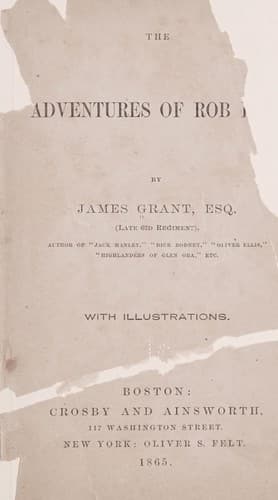
Biographical fiction; Historical fiction; Outlaws -- Fiction; Rob Roy, 1671-1734 -- Fiction; Scotland -- History -- 1689-1745 -- Fiction
Captured by treachery, Alaster of Glenstrae, the gallant victor of
Glenfruin, was ignominiously hanged, at the cross of Edinburgh, with
all his nearest kinsmen, the sole honour awarded to him being a
loftier gibbet than the rest.
By an Act of the Scottish Legislature, the surname of MacGregor was
abolished, and they were compelled to adopt others. Some called
themselves Gregory and Gregorson, and some Mallet, of whom the
grandfather of the poet of that name was one. Many took the name of
Grahame, but many more allied themselves with the powerful House of
Argyle, taking the surname of "the Great Clan;" hence, a hundred
years after the grass had grown above the graves of the dead in
Glenfruin, we find Rob Roy designating himself _Campbell_, the name
of his mother!
The same Act ordained that none of the race of Alpine should have in
their possession any other weapon than a pointless knife, wherewith
to cut their food; yet, in defiance of the Act, the Clan Gregor went
armed to the teeth as usual.
Bloodhounds were employed to track them in their retreats; and their
very children were abstracted, and brought up in hatred of the blood
they inherited. But the Celtic nature was soon averse to such modes
of suppressing a warlike and time-honoured clan; and the Camerons
alone maintained the war against the MacGregors, who, on being joined
by the MacPhersons, met them in battle in Brae Lochaber, and gave
one-half of them a lesson in charity, by cutting the other to pieces.
After the battle of Glenfruin, seven MacGregors, who were pursued by
a body of Colquhouns, came over the mountains of Glencoe and
Glenorchy, down by the lone and lovely shore of Lochiel and the
birchen woods that border on the wild waters of the Spean, till they
found a brief shelter in the farmhouse of Tirindrish, which was then
occupied by a Cameron.
Alarmed by the approach of the Colquhouns, they fled again, and took
shelter in a cavern, which the Cameron, actuated either by treachery
or timidity, pointed out to the pursuers. The toil-worn fugitives
were attacked with sword and pistol. Six were slain, and lie buried,
where some pines, the badge of their clan, were lately planted, in
memory of the event. The seventh fled to a little distance, but was
overtaken, beheaded, and buried beside a stream, where a friend of
the author lately found his skull, which the water had laid bare, by
washing away the bank, in which the other bones lie yet embedded.
After their slaughter, the Colquhouns went back to Luss; but the
farmhouse of Tirindrish was now said to be haunted from time to time
by a headless figure. The Cameron became alarmed, and brought
thither a _Taischatr_, or seer, who saw it also--the dim outline of a
shadowy and bare-legged Highlander, without a head, but with a
remarkable swelling on the right knee, a disease of which the
treacherous farmer had long complained; and hence the seer intimated
that the figure represented _himself_!
Public-domain text, read in full here on John Shaqi.
Reviews
Reviews
No reviews yet
Be the first to share your thoughts on this work.
Join the Discussion
Join the discussion
Sign in to leave a comment or review.
Sign InorCreate an account