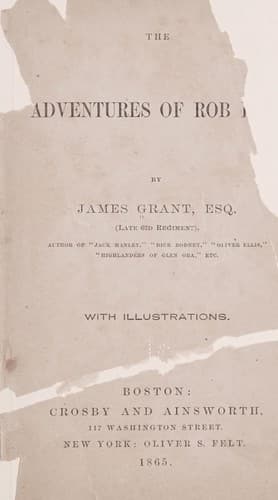
Biographical fiction; Historical fiction; Outlaws -- Fiction; Rob Roy, 1671-1734 -- Fiction; Scotland -- History -- 1689-1745 -- Fiction
Rob retired twelve Scottish (or twenty English) miles further into
the Highlands, but he still remained upon what he considered his own
territory; and there, building what was termed a creel-house,
resolved to live in open war with, and defiance of, the Duke of
Montrose, who, by a regular form of law, had now become, for a time,
legal proprietor of Inversnaid and Craigrostan!
In the wilds of Glendochart Rob began to frame daring political
schemes, which the protection afforded to him by his kinsman, Sir
John Campbell, of Glenorchy, now Earl of Breadalbane, enabled him to
mature, and arms were collected and hidden in secret places, and men
were prepared for the coming strife.
Aware that the Paper Court of Dunedin (as the Highlanders
disdainfully term the College of Justice at Edinburgh) was not a
place where a Celt--especially a MacGregor--was likely to obtain
equity, when opposed to a powerful duke who supported the Whigs,
whose government Rob abhorred--he resolved to set all law at
defiance, and, like a true Scot of the olden time, to confide in his
sword alone.
In addition to the seizure of all he possessed on earth, the
advertisements which appeared, again and again, in the columns of the
"Edinburgh Evening Courant," stung him to the soul; for therein he
was stigmatized as a fraudulent bankrupt, an outlaw, and robber--as
if it was sought to make him one, for the express purpose of
destroying him. One runs as follows:--
"All magistrates and officers of his Majesty's forces are entreated
to seize upon Rob Roy, and the money which he carries with him, until
the persons concerned in the money may be heard against him; and that
notice be given, when he is apprehended, to the keepers of the
Exchange Coffee-house at Edinburgh, and the keeper of the
Coffee-house at Glasgow, where the parties concerned will be
advertised, and the seizers shall be very reasonably rewarded for
their pains." (_Edinburgh Courant_, No. 1,058.)
"Now, Helen," said he, trampling the paper under foot, and then
casting it into the bogwood fire that blazed on the floor of their
cabin, "by the soul o' Ciar Mhor, our foes shall find that the days
of Glenfruin are come again! Henceforward, all is at end between us
and the Lowlanders, and we shall devote ourselves to war and death!"
When Craigrostan, the last of his patrimony, was taken from him,
MacGregor was so exasperated (to quote Browne's "Highland History")
"that he declared perpetual war against the duke, and resolved that
in future he should supply himself with cattle from his grace's
estates, a resolution which he literally kept, and for THIRTY years
he carried off the duke's flocks with impunity, and disposed of them
publicly in different parts of the country."
Public-domain text, read in full here on John Shaqi.
Reviews
Reviews
No reviews yet
Be the first to share your thoughts on this work.
Join the Discussion
Join the discussion
Sign in to leave a comment or review.
Sign InorCreate an account