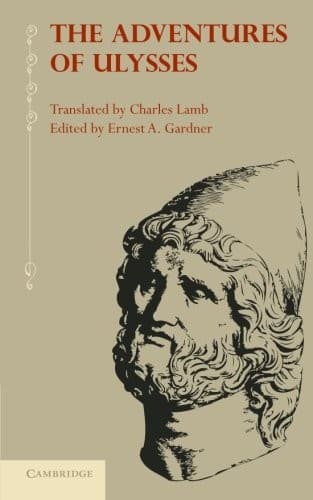
Homer. Odyssey -- Adaptations; Odysseus, King of Ithaca (Mythological character) -- Juvenile literature
Eurylochus, who beheld nothing of these sad changes from where he was
stationed without the gate, only instead of his companions that entered
(who he thought had all vanished by witchcraft) beheld a herd of swine,
hurried back to the ship, to give an account of what he had seen; but so
frighted and perplexed, that he could give no distinct report of anything,
only he remembered a palace, and a woman singing at her work, and gates
guarded by lions. But his companions, he said, were all vanished.
Then Ulysses, suspecting some foul witchcraft, snatched his sword and his
bow, and commanded Eurylochus instantly to lead him to the place. But
Eurylochus fell down, and, embracing his knees, besought him by the name
of a man whom the gods had in their protection, not to expose his safety,
and the safety of them all, to certain destruction.
"Do thou then stay, Eurylochus," answered Ulysses: "eat thou and drink in
the ship in safety; while I go alone upon this adventure: necessity, from
whose law is no appeal, compels me."
So saying, he quitted the ship and went on shore, accompanied by none;
none had the hardihood to offer to partake that perilous adventure with
him, so much they dreaded the enchantments of the witch. Singly he pursued
his journey till he came to the shining gates which stood before her
mansion; but when he essayed to put his foot over her threshold, he was
suddenly stopped by the apparition of a young man, bearing a golden rod in
his hand, who was the god Mercury. He held Ulysses by the wrist, to stay
his entrance; and "Whither wouldest thou go?" he said, "O thou most erring
of the sons of men! knowest thou not that this is the house of great
Circe, where she keeps thy friends in a loathsome sty, changed from the
fair forms of men into the detestable and ugly shapes of swine? art thou
prepared to share their fate, from which nothing can ransom thee?" But
neither his words nor his coming from heaven could stop the daring foot of
Ulysses, whom compassion for the misfortune of his friends had rendered
careless of danger: which when the god perceived, he had pity to see
valour so misplaced, and gave him the flower of the herb _moly_, which is
sovereign against enchantments. The moly is a small unsightly root, its
virtues but little known and in low estimation; the dull shepherd treads
on it every day with his clouted shoes; but it bears a small white flower,
which is medicinal against charms, blights, mildews, and damps. "Take this
in thy hand," said Mercury, "and with it boldly enter her gates; when she
shall strike thee with her rod, thinking to change thee, as she has
changed thy friends, boldly rush in upon her with thy sword, and extort
from her the dreadful oath of the gods, that she will use no enchantments
against thee; then force her to restore thy abused companions." He gave
Ulysses the little white flower, and, instructing him how to use it,
vanished.
Public-domain text, read in full here on John Shaqi.
Reviews
Reviews
No reviews yet
Be the first to share your thoughts on this work.
Join the Discussion
Join the discussion
Sign in to leave a comment or review.
Sign InorCreate an account