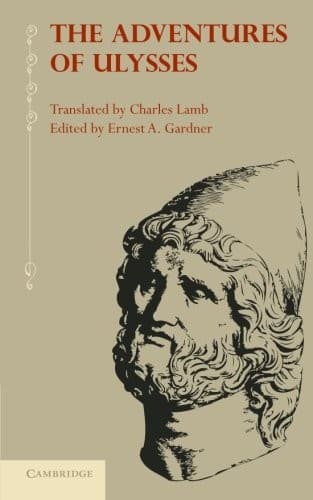
Homer. Odyssey -- Adaptations; Odysseus, King of Ithaca (Mythological character) -- Juvenile literature
At the stern of his solitary ship Ulysses sat, and steered right artfully.
No sleep could seize his eyelids. He beheld the Pleiads, the Bear, which
is by some called the Wain, that moves round about Orion, and keeps still
above the ocean, and the slow-setting sign Bootes, which some name the
Wagoner. Seventeen days he held his course, and on the eighteenth the
coast of Phaeacia was in sight. The figure of the land, as seen from the
sea, was pretty and circular, and looked something like a shield.
Neptune, returning from visiting his favourite Aethiopians, from the
mountains of the Solymi, descried Ulysses ploughing the waves, his domain.
The sight of the man he so much hated for Polyphemus's sake, his son,
whose eye Ulysses had put out, set the god's heart on fire; and snatching
into his hand his horrid sea-sceptre, the trident of his power, he smote
the air and the sea, and conjured up all his black storms, calling down
night from the cope of heaven, and taking the earth into the sea, as it
seemed, with clouds, through the darkness and indistinctness which
prevailed; the billows rolling up before the fury of all the winds, that
contended together in their mighty sport.
Then the knees of Ulysses bent with fear, and then all his spirit was
spent, and he wished that he had been among the number of his countrymen
who fell before Troy, and had their funerals celebrated by all the Greeks,
rather than to perish thus, where no man could mourn him or know him.
As he thought these melancholy thoughts, a huge wave took him and washed
him overboard, ship and all upset amidst the billows, he struggling afar
off, clinging to her stern broken off which he yet held, her mast cracking
in two with the fury of that gust of mixed winds that struck it, sails and
sailyards fell into the deep, and he himself was long drowned under water,
nor could get his head above, wave so met with wave, as if they strove
which should depress him most; and the gorgeous garments given him by
Calypso clung about him, and hindered his swimming; yet neither for this,
nor for the overthrow of his ship, nor his own perilous condition, would
he give up his drenched vessel; but, wrestling with Neptune, got at length
hold of her again, and then sat in her hull, insulting over death, which
he had escaped, and the salt waves which he gave the seas again to give to
other men; his ship, striving to live, floated at random, cuffed from wave
to wave, hurled to and fro by all the winds: now Boreas tossed it to
Notus, Notus passed it to Eurus, and Eurus to the West Wind, who kept up
the horrid tennis.
Public-domain text, read in full here on John Shaqi.
Reviews
Reviews
No reviews yet
Be the first to share your thoughts on this work.
Join the Discussion
Join the discussion
Sign in to leave a comment or review.
Sign InorCreate an account