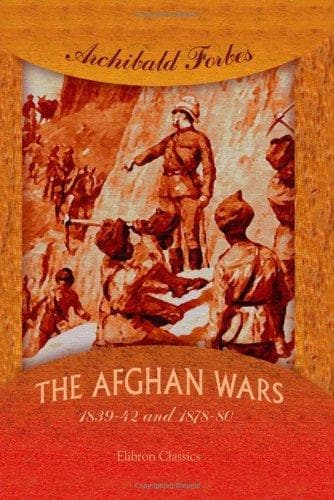
The Afghan Wars 1839-42 and 1878-80Forbes, Archibald
History
The Afghan Wars 1839-42 and 1878-80
Forbes, Archibald
Afghan Wars
No other course was now open to Her Majesty's Government than to insist
on the reception at Cabul of a British mission. The gallant veteran
officer Sir Neville Chamberlain, known to be held in regard by the
Ameer, was named as Envoy, and an emissary was sent to Cabul in advance
with information of the date fixed for the setting out of the mission.
Shere Ali was greatly perplexed, and begged for more time. 'It is not
proper,' he protested, 'to use pressure in this way; it will tend to a
complete rupture.' But Sir Neville Chamberlain was satisfied that the
Ameer was trifling with the Indian Government; and he had certain
information that the Ameer, his Ministers, and the Afghan outpost
officers, had stated plainly that, if necessary, the advance of the
mission would be arrested by force. This was what in effect happened
when on September 21st Major Cavagnari rode forward to the Afghan post
in the Khyber Pass. The officer who courteously stopped him assured him
that he had orders to oppose by force the progress of Sir Neville and
his mission, so Cavagnari shook hands with the Afghan major and rode
back to Peshawur.
The Viceroy sought permission to declare war immediately,
notwithstanding his condition of unpreparedness; but the Home Government
directed him instead to require in temperate language an apology and the
acceptance of a permanent mission, presenting at the same time the
ultimatum that if a satisfactory reply should not be received on or
before the 20th November hostilities would immediately commence.
Meanwhile military preparations were actively pushed forward. The scheme
of operations was as follows: three columns of invasion were to move
simultaneously, one through the Khyber Pass to Dakka, another through
the Kuram valley, south of the Khyber, with the Peiwar Pass as its
objective, and a third from Quetta into the Pisheen valley, to march
forward to Candahar after reinforcement by a division from Mooltan. To
General Sir Sam Browne was assigned the command of the Khyber column,
consisting of about 10,000 men, with thirty guns; to General Roberts the
command of the Kuram valley column, of about 5,500 men, with twenty-four
guns; and to General Biddulph the command of the Quetta force, numbering
some 6000 men, with eighteen guns. When General Donald Stewart should
bring up from Mooltan the division which was being concentrated there,
he was to command the whole southern force moving on Candahar. The
reserve division gathering at Hassan Abdul and commanded by General
Maude, would support the Khyber force; another reserve division massing
at Sukkur under General Primrose, would act in support of the Candahar
force; and a contingent contributed by the Sikh Feudatory States and
commanded by Colonel Watson, was to do duty on the Kurum line of
communication. The Generals commanding columns were to act independently
of each other, taking instructions direct from Army and Government
headquarters.
Public-domain text, read in full here on John Shaqi.
Reviews
Reviews
No reviews yet
Be the first to share your thoughts on this work.
Elsewhere in the archive
Join the Discussion
Join the discussion
Sign in to leave a comment or review.
Sign InorCreate an account