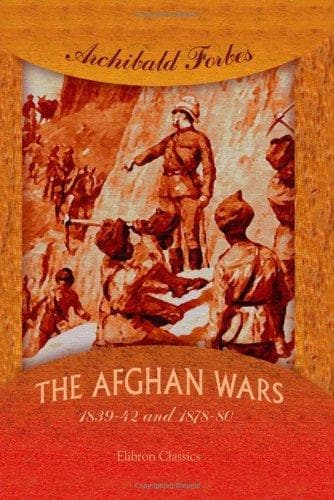
The Afghan Wars 1839-42 and 1878-80Forbes, Archibald
History
The Afghan Wars 1839-42 and 1878-80
Forbes, Archibald
Afghan Wars
unlikelihood, because of the Russo-Turkish war then impending, of any
_rapprochement_ between the Ameer and the Russian authorities in Central
Asia. The Viceroy withdrew his Vakeel from Cabul, and in the recognition
of the Ameer's attitude of 'isolation and scarcely veiled hostility'
Lord Salisbury authorised Lord Lytton to protect the British frontier
by such measures as circumstances should render expedient, 'without
regard to the wishes of the Ameer or the interests of his dynasty.' Lord
Lytton took no measures, expedient or otherwise, in the direction
indicated by Lord Salisbury; the Ameer, as if he had been a petted boy
consigned to the corner, was abandoned to his sullen 'isolation,' and
the Russians adroitly used him to involve us in a war which lasted two
years, cost us the lives of many valiant men, caused us to incur an
expenditure of many millions, and left our relations with Afghanistan in
all essential respects in the same condition as Lord Lytton found them
when he reached India with the 'new policy' in his pocket.
If the Russians could execute as thoroughly as they can plan skilfully,
there would be hardly any limit to their conquests. When England was
mobilising her forces after the treaty of San Stefano, and ordering into
the Mediterranean a division of sepoys drawn from the three presidencies
of her Indian Empire, Russia for her part was concerting an important
diversion in the direction of the north-western frontier of that great
possession. But for the opportune conclusion of the treaty of Berlin,
the question as to the ability of sepoy troops stiffened by British
regiments to cope with the mixed levies of the Tzar might have been
tried out on stricken fields between the Oxus and the Indus. When
Gortschakoff returned from Berlin to St Petersburg with his version of
'Peace with Honour'--Bessarabia and Batoum thrown in--Kaufmann had to
countermand the concentration of troops that had been in progress on the
northern frontier of Afghanistan. But the Indian division was still much
in evidence in the Mediterranean, its tents now gleaming on the brown
slopes of Malta, now crowning the upland of Larnaca and nestling among
the foliage of Kyrenea. Kaufmann astutely retorted on this demonstration
by despatching, not indeed an expedition, but an embassy to Cabul; and
when Stolietoff, the gallant defender of the Schipka Pass, rode into the
Balla Hissar on August 11th, 1878, Shere Ali received him with every
token of cordiality and regard.
Public-domain text, read in full here on John Shaqi.
Reviews
Reviews
No reviews yet
Be the first to share your thoughts on this work.
Elsewhere in the archive
Join the Discussion
Join the discussion
Sign in to leave a comment or review.
Sign InorCreate an account