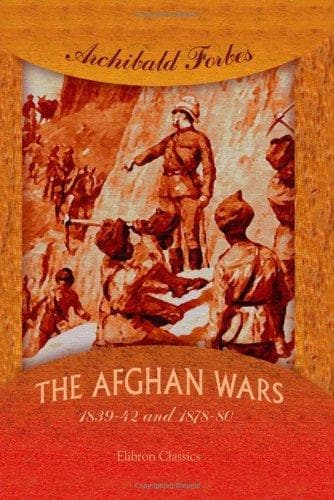
The Afghan Wars 1839-42 and 1878-80Forbes, Archibald
History
The Afghan Wars 1839-42 and 1878-80
Forbes, Archibald
Afghan Wars
Instructions had been given by the Viceroy that Yakoub Khan should be
received in the British camp with all honour and distinction. When his
approach was announced on May 8th, Cavagnari and a number of British
officers rode out to meet him; when he reached the camp, a royal salute
greeted him, a guard of honour presented arms, and Sir Sam Browne and
his staff gave him a ceremonious welcome. Cavagnari had full powers to
represent his Government in the pending negotiations, as to the terms of
which he had received from the Viceroy detailed instructions. The Ameer
and his General-in-Chief, Daoud Shah, came to the conference attired in
Russian uniforms. The negotiations were tedious, for the Ameer, his
Minister, and his General made difficulties with a somewhat elaborate
stupidity, but Cavagnari as a diplomatist possessed the gift of being at
once patient and firm; and at length on May 26th the treaty of peace was
signed, and formally ratified by the Viceroy four days later. By the
treaty of Gundamuk Afghanistan was deprived for the time of its
traditional character of a 'buffer state,' and its Ameer became
virtually a feudatory of the British Crown. He was no longer an
independent prince; although his titular rank and a nominal sovereignty
remained to him, his position under its articles was to be analogous to
that of the mediatised princes of the German Empire. The treaty vested
in the British Government the control of the external relations of
Afghanistan. The Ameer consented to the residence of British Agents
within his dominions, guaranteeing their safety and honourable
treatment, while the British Government undertook that its
representatives should not interfere with the internal administration of
the country. The districts of Pisheen, Kuram, and Sibi were ceded to the
British Government along with the permanent control of the Khyber and
Michnai passes, and of the mountain tribes inhabiting the vicinity of
those passes; all other Afghan territory in British occupation was to be
restored. The obligations to which the treaty committed the British
Government were that it should support the Ameer against foreign
aggression with arms, money, or troops at its discretion, and that it
should pay to him and his successor an annual subsidy of £60,000.
Commercial relations between India and Afghanistan were to be protected
and encouraged; a telegraph line between Cabul and the Kuram was
forthwith to be constructed; and the Ameer was to proclaim an amnesty
relieving all and sundry of his subjects from punishment for services
rendered to the British during the war.
Public-domain text, read in full here on John Shaqi.
Reviews
Reviews
No reviews yet
Be the first to share your thoughts on this work.
Elsewhere in the archive
Join the Discussion
Join the discussion
Sign in to leave a comment or review.
Sign InorCreate an account