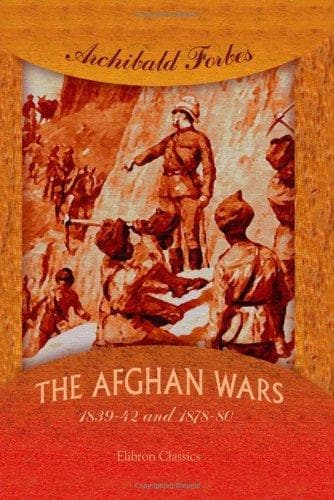
The Afghan Wars 1839-42 and 1878-80Forbes, Archibald
History
The Afghan Wars 1839-42 and 1878-80
Forbes, Archibald
Afghan Wars
That the treaty of Gundamuk involved our Indian Empire in serious
responsibilities is obvious, and those responsibilities were the more
serious that they were vague and indefinite, yet none the less binding
on this account. It is probable that its provisions, if they had
remained in force, would have been found in the long run injurious to
the interests of British India. For that realm Afghanistan has the value
that its ruggedness presents exceptional obstacles to the march through
it of hostile armies having the Indian frontier for their objective, and
this further and yet more important value that the Afghans by nature are
frank and impartial Ishmaelites, their hands against all foreigners
alike, no matter of what nationality. If this character be impaired,
what virtue the Afghan has in our eyes is lost. In his implacable
passion for independence, in his fierce intolerance of the Feringhee
intruder, he fulfils in relation to our Indian frontier a kindred office
to that served by abattis, _cheveux de frise,_ and wire entanglements in
front of a military position. The short-lived treaty, for which the
sanguine Mr Stanhope claimed that it had gained for England 'a friendly,
an independent, and a strong Afghanistan,' may now be chiefly remembered
because of the circumstance that it gave effect for the moment to Lord
Beaconsfield's 'scientific frontier.'
The withdrawal of the two northern forces to positions within the new
frontier began immediately on the ratification of the treaty of
Gundamuk, the evacuation of Candahar being postponed for sanitary
reasons until autumn. The march of Sir Sam Browne's force from the
breezy upland of Gundamuk down the passes to Peshawur, made as it was in
the fierce heat of midsummer through a region of bad name for
insalubrity, and pervaded also by virulent cholera, was a ghastly
journey. That melancholy pilgrimage, every halting-place in whose course
was marked by graves, and from which the living emerged 'gaunt and
haggard, marching with a listless air, their clothing stiff with dried
perspiration, their faces thick with a mud of dust and sweat through
which their red bloodshot eyes looked forth, many suffering from heat
prostration,' dwells in the memory of British India as the 'death
march,' and its horrors have been recounted in vivid and pathetic words
by Surgeon-Major Evatt, one of the few medical officers whom,
participating in it, it did not kill.
CHAPTER II: THE OPENING OF THE SECOND CAMPAIGN
Public-domain text, read in full here on John Shaqi.
Reviews
Reviews
No reviews yet
Be the first to share your thoughts on this work.
Elsewhere in the archive
Join the Discussion
Join the discussion
Sign in to leave a comment or review.
Sign InorCreate an account