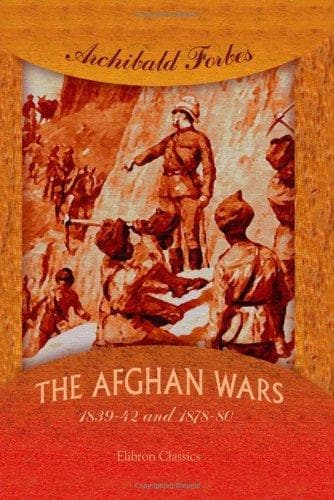
The Afghan Wars 1839-42 and 1878-80Forbes, Archibald
History
The Afghan Wars 1839-42 and 1878-80
Forbes, Archibald
Afghan Wars
There were many who mistrusted the stability of the treaty of Gundamuk.
Perhaps in his heart Sir Louis Cavagnari may have had his misgivings,
for he was gifted with shrewd insight, and no man knew the Afghan nature
better; but outwardly, in his quiet, resolute manner, he professed the
fullest confidence. Cavagnari was a remarkable man. Italian and Irish
blood commingled in his veins. Both strains carry the attributes of
vivacity and restlessness, but Cavagnari to the superficial observer
appeared as phlegmatic as he was habitually taciturn. This sententious
imperturbability was only on the surface; whether it was a natural
characteristic or an acquired manner is not easy to decide. Below the
surface of measured reticent composure there lay a temperament of ardent
enthusiasm, and not less ardent ambition. In subtlety he was a match for
the wiliest Oriental, whom face to face he dominated with a placid
dauntless masterfulness that was all his own. The wild hill tribes among
whom he went about escortless, carrying his life continually in his
hand, recognised the complex strength of his personal sway, and feared
at once and loved the quiet, firm man, the flash of whose eye was
sometimes ominous, but who could cow the fiercest hillman without losing
a tittle of his cool composure.
[Illustration: _From a Photograph by Bourne & Shepherd: Sir Louis
Cavagnari and Sirdars_]
Cavagnari had negotiated the treaty of Gundamuk, the real importance of
which consisted in the Afghan acceptance of a British Resident at Cabul.
The honour, the duty, and the danger naturally fell to him of being the
first occupant of a post created mainly by his own mingled tact and
strength. Many of his friends regarded him in the light of the leader of
a forlorn hope, and probably Cavagnari recognised with perfect clearness
the risks which encompassed his embassy; but apart from mayhap a little
added gravity in his leave-takings when he quitted Simla, he gave no
sign. It was not a very imposing mission at whose head he rode into the
Balla Hissar of Cabul on July 24th, 1879. His companions were his
secretary, Mr William Jenkins, a young Scotsman of the Punjaub Civil
Service, Dr Ambrose Kelly, the medical officer of the embassy, and the
gallant, stalwart young Lieutenant W. R. P. Hamilton, V.C., commanding
the modest escort of seventy-five soldiers of the Guides. It was held
that an escort so scanty was sufficient, since the Ameer had pledged
himself personally for the safety and protection of the mission. The
Envoy was received with high honour, and conducted to the roomy quarters
in the Balla Hissar which had been prepared as the Residency, within
easy distance of the Ameer's palace. Unquestionably the mission was
welcome neither to the Afghan ruler nor to the people, but Cavagnari,
writing to the Viceroy, made the best of things. The arrival at the
adjacent Sherpur cantonments of the Herat regiments in the beginning of
August was extremely unfortunate for the mission.
Public-domain text, read in full here on John Shaqi.
Reviews
Reviews
No reviews yet
Be the first to share your thoughts on this work.
Elsewhere in the archive
Join the Discussion
Join the discussion
Sign in to leave a comment or review.
Sign InorCreate an account