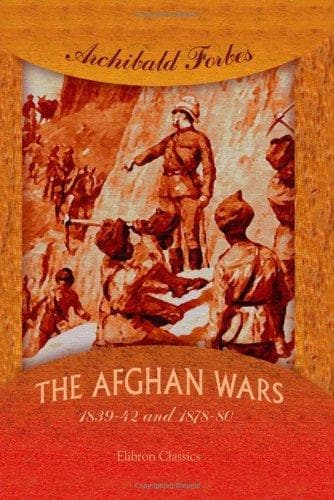
The Afghan Wars 1839-42 and 1878-80Forbes, Archibald
History
The Afghan Wars 1839-42 and 1878-80
Forbes, Archibald
Afghan Wars
The soldiers had not long to wait for the first fight of the campaign.
On the afternoon of the 5th Baker's brigade, with most of the cavalry
and artillery, and with the 92d Highlanders belonging to Macpherson's
brigade, camped on the plain to the south of the village of Charasiah,
Macpherson remaining one march in rear to escort the convoy of
ammunition and stores. North of Charasiah rises a semicircular curtain
of hills ascending in three successive tiers, the most distant and
loftiest range closing in the horizon and shutting out the view of
Cabul, distant only about eleven miles. The leftward projection of the
curtain, as one looks northward, comes down into the plain almost as far
as and somewhat to the left of Charasiah, dividing the valley of
Charasiah from the outer plain of Chardeh. To the right front of
Charasiah, distant from it about three miles, the range is cleft by the
rugged and narrow Sung-i-Nawishta Pass, through which run the Logur
river and the direct road to Cabul by Beni Hissar. Information had been
received that the Afghans were determined on a resolute attempt to
prevent the British force from reaching Cabul, and the position beyond
Charasiah seemed so tempting that it was regarded as surprising that
cavalry reconnaissances sent forward on three distinct roads detected no
evidences of any large hostile gathering.
But next morning 'showed another sight.' At dawn on the 6th General
Roberts, anxious to secure the Sung-i-Nawishta Pass and to render the
track through it passable for guns, sent forward his pioneer battalion
with a wing of the 92d and two mountain guns. That detachment had gone
out no great distance when the spectacle before it gave it pause. From
the Sung-i-Nawishta defile, both sides of which were held, the
semicircular sweep of the hill-crests was crowned by an Afghan host in
great strength and regular formation. According to subsequent
information no fewer than thirteen regiments of the Afghan regular army
took part in the combat, as well as large contingents of irregular
fighting men from Cabul and the adjoining villages, while the British
camp was threatened from the heights on either side by formidable bodies
of tribesmen, to thwart whose obviously intended attack on it a
considerable force had to be retained. The dispositions of the Afghan
commander Nek Mahomed Khan were made with some tactical skill. The
Sung-i-Nawishta Pass itself, the heights on either side, and a low
detached eminence further forward, were strongly held by Afghan
infantry; in the mouth of the pass were four Armstrong guns, and on the
flanking height twelve mountain guns were in position. The projecting
spur toward Charasiah which was the extreme right of the Afghan
position, was held in force, whence an effective fire would bear on the
left flank of a force advancing to a direct attack on the pass. But
Roberts was not the man to play into the hands of the Afghan tactician.
Public-domain text, read in full here on John Shaqi.
Reviews
Reviews
No reviews yet
Be the first to share your thoughts on this work.
Elsewhere in the archive
Join the Discussion
Join the discussion
Sign in to leave a comment or review.
Sign InorCreate an account