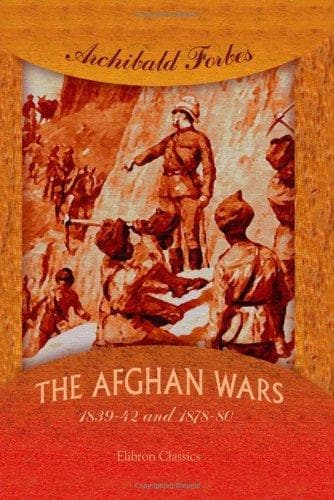
The Afghan Wars 1839-42 and 1878-80Forbes, Archibald
History
The Afghan Wars 1839-42 and 1878-80
Forbes, Archibald
Afghan Wars
The battle of Candahar was an effective finale to the latest of our
Afghan wars, and it is in this sense that it is chiefly memorable. The
gallant men who participated in the winning of it must have been the
first to smile at the epithets of 'glorious' and 'brilliant' which were
lavished on the victory. In truth, if it had not been a victory our arms
would have sustained a grave discredit. The soldiers of Roberts and
Stewart had been accustomed to fight and to conquer against heavy
numerical odds, which were fairly balanced by their discipline and the
superiority of their armament. But in the battle of Candahar the
numerical disparity was non-existent, and Ayoub had immensely the
disadvantage as regarded trained strength. His force according to the
reckoning ascertained by the British general, amounted all told to
12,800 men. The strength of the British force, not including the detail
of Bombay troops garrisoning Candahar, was over 12,000. But this army
12,000 strong, consisted entirely of disciplined soldiers of whom over
one-fifth were Europeans. The accepted analysis of Ayoub's army shows it
to have consisted of 4000 regular infantry, 800 regular cavalry, 5000
tribal irregular infantry of whom an indefinite proportion was no doubt
ghazees, and 3000 irregular horsemen. In artillery strength the two
forces were nearly equal. When it is remembered that Charasiah was won
by some 2500 soldiers of whom only about 800 were Europeans, contending
against 10,000 Afghans in an exceptionally strong position and well
provided with artillery, Sir Frederick Roberts' wise decision to make
assurance doubly sure in dealing with Ayoub at Candahar stands out very
strikingly. Perforce in his battles around Cabul he had taken risks, but
because those adventures had for the most part been successful he was
not the man to weaken the certainty of an all-important issue by
refraining from putting into the field every soldier at his disposal.
And he was wisely cautious in his tactics. That he was strong enough to
make a direct attack by storming the Babawali Kotul and the Pir Paimal
hill was clear in the light of previous experience. But if there was
more 'brilliancy' in a direct attack, there was certain to be heavier
loss than would be incurred in the less dashing turning movement, and
Sir Frederick with the true spirit of a commander chose the more
artistic and less bloody method of earning his victory. It did not cost
him dear. His casualties of the day were thirty-six killed including
three officers, and 218 wounded among whom were nine officers.
Public-domain text, read in full here on John Shaqi.
Reviews
Reviews
No reviews yet
Be the first to share your thoughts on this work.
Elsewhere in the archive
Join the Discussion
Join the discussion
Sign in to leave a comment or review.
Sign InorCreate an account