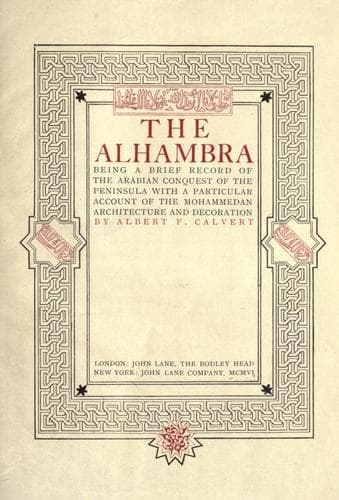
The Alhambra: being a brief record of the Arabian conquest of the Peninsula with a particular account of the Mohammedan architecture and decorationCalvert, Albert Frederick
Islamic
The Alhambra: being a brief record of the Arabian conquest of the Peninsula with a particular account of the Mohammedan architecture and decoration
The Alhambra is built on a crowning height that hangs over the River
Darro; its long lines of walls and towers follow the curves and dips of
the ground just as a consummate artist would have placed them; the
wooded slopes, kept green by water-courses, are tenanted by
nightingales, singing as if in pain at the tender scene of desolate
beauty.
Granada, which, under the Moors, was populated by half-a-million
inhabitants, knew no slow decline, but flourished until it toppled to
its fall. The date of its ruin is 2nd January, 1492, when the banner of
Castile first floated from the towers of the Alhambra. To the fatal
influence of a beautiful woman--Isabel de Solis--may be attributed, in
great part, the destruction of the Moslem cause. Isabel was the daughter
of the Governor of Martos, a town of Andalusia to the north-west of
Granada. In a foray by the Moors she was captured, and became the
favourite Sultana of Abu-l-hasan, King of Granada. Her Moorish
appellation is Zoraya--“Morning Star”--in allusion to her surpassing
loveliness, on account of which Ayeshah, another wife and cousin of
Abu-l-hasan, became jealous of her rival. This necessarily led to
dissension; conspiracy was rampant, and the Moorish Court became
separated into two parties. Of the most powerful families of Granada,
the Zegris espoused the cause of Ayeshah; while the Beni Cerraj
(Abencerrages) championed that of the “Morning Star.” In June, 1482,
Abu-Abdillah (Boabdil), son of Ayeshah, dethroned Abu-l-hasan, his
father. Thus the Moorish house was divided against itself at the very
time when Castile and Aragon became united by the marriage of Ferdinand
and Isabella. On Boabdil’s defeat and capture at Lucena in 1483, the old
king returned to Granada and was enthroned, but quickly abdicated in
favour of his brother, Mohammed (XII.), called Ez-zaghal, the Valiant.
Boabdil, later, was re-instated; but, becoming a mere instrument and
vassal of Ferdinand, finally surrendered himself and his kingdom to the
Christian king.
[Illustration: INTERIOR OF THE “CAPTIVE’S” (ISABEL DE SOLIS) TOWER.]
For the true character of Ferdinand consult Shakespeare, who understood
all things--“who didst the stars and sunbeams know.” He describes
Ferdinand, by the mouth of our eighth Henry’s ill-fated queen, Katharine
of Aragon, daughter of Ferdinand and Isabella:
“....Ferdinand,
My father, King of Spain, was reckon’d
The _wisest_ prince, that there had reign’d by many
A year before: ...”
Henry VIII., Act II.
And of Katharine’s qualities, King Henry, in all things else
unrelenting, speaks in high terms:
“....Thou art, alone,--
If thy rare qualities, sweet gentleness,
Thy meekness saint-like, wife-like government,
Obeying in commanding, and thy parts
Sovereign and pious else, could speak thee out,--
_The queen of earthly queens_.”
Henry VIII., Act II.
Public-domain text, read in full here on John Shaqi.
Reviews
Reviews
No reviews yet
Be the first to share your thoughts on this work.
Join the Discussion
Join the discussion
Sign in to leave a comment or review.
Sign InorCreate an account