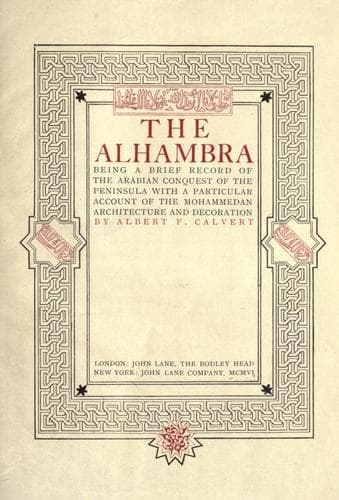
The Alhambra: being a brief record of the Arabian conquest of the Peninsula with a particular account of the Mohammedan architecture and decorationCalvert, Albert Frederick
Islamic
The Alhambra: being a brief record of the Arabian conquest of the Peninsula with a particular account of the Mohammedan architecture and decoration
[Illustration: DETAIL OF THE ONLY ANCIENT “JALOUSIE” REMAINING IN THE
ALHAMBRA.]
TORRE DE LA VELA--THE WATCH-TOWER.
Here, an inscription records, the Christian flag was first hoisted by
the Cardinal Mendoza and his brother. The panorama from the roof of this
Tower is glorious. Below, lies Granada, belted with plantations; beyond,
expands the Vega, guarded like an Eden by a wall of mountains. It is a
scene for painters to sketch and for poets to describe.
The _Torre de la Vela_ is so called, because on this _watch-tower_ hangs
a silver-tongued bell, which is heard on a still night even at Loja,
thirty miles away. The bell is rung on 2nd January, the anniversary of
the surrender of Granada. Maidens come on this day to strike the bell,
which act ensures a
[Illustration: THE INFANTAS TOWER.]
husband, and of excellence in proportion to the noise made, which, it
need not be said, is considerable and continuous.
TORRE DE LAS INFANTAS--TOWER OF THE INFANTAS.
TORRE DEL CAUTIVO--CAPTIVE’S TOWER.
On the north-east wall of the fortress are several towers partly in
ruin, which retain traces of beautiful decorations in the interior. The
_Torre del Cautivo_ and the _Torre de las Infantas_ are the best
preserved. They appear to have formed detached habitations complete in
themselves; and from their position in this retired part of the
fortress, and the extreme beauty of the internal decorations, there can
be little doubt that they were isolated residences of favourite
Sultanás.
TORRE DEL HOMENAGE--HOMAGE TOWER.
The Homage Tower rises at the end of the _Pelota_, or Fives, Court, the
wall of which much disfigures the Place of the Cisterns. In this Homage
Tower is a Roman votive altar, embedded by the Moors in the masonry,
inscribed by “the grateful Valerius to his most indulgent wife,
Cornelia.”
TORRE DE LA AQUA--TOWER OF THE AQUEDUCT.
Close to the two Towers, _Del Candil_ and _De la Cautiva_, is the corner
Tower _De la Aqua_, where an aqueduct, stemming the ravine, supplies the
hill with water.
THE LADIES’ TOWER.
The interior of the Ladies’ Tower was formerly remarkable for an alcove
of extraordinary beauty. The Tower is isolated, and, unfortunately, a
tourist purchased it for a trifling sum. After stripping the marvellous
decoration--a masterpiece of Yúsuf I.--the aforesaid traveller
magnanimously presented the denuded carcass to the State.
THE MUSEUM.
In a chamber near to the entrance of the Court of the Lions, a
collection of Moorish remains has been brought together. A conspicuous
object is the marble sarcophagus, or tank, brought from the _Alcazába_,
with basso-relievos of animals;
[Illustration: DETAILS OF THE ENTRANCE DOOR TO THE MUSEUM OF THE
ALHAMBRA.]
among them the “deer-slaying lion,” which occurs so often in Greek art,
and, like the Mithraic daughter of the bull, may be the symbol of some
hieratic mystery, possibly the triumph of the evil principle. It is
difficult to say whether this rude
Public-domain text, read in full here on John Shaqi.
Reviews
Reviews
No reviews yet
Be the first to share your thoughts on this work.
Elsewhere in the archive
Join the Discussion
Join the discussion
Sign in to leave a comment or review.
Sign InorCreate an account