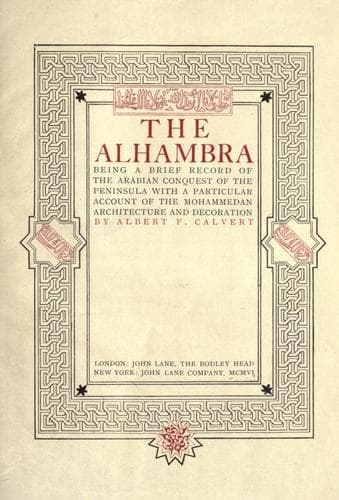
The Alhambra: being a brief record of the Arabian conquest of the Peninsula with a particular account of the Mohammedan architecture and decorationCalvert, Albert Frederick
Islamic
The Alhambra: being a brief record of the Arabian conquest of the Peninsula with a particular account of the Mohammedan architecture and decoration
[Illustration: BAS-RELIEF, NOW IN THE MUSEUM OF THE ALHAMBRA.]
[Illustration: THE SAME SUBJECT FROM AN ENGRAVING IN MURPHY’S ARABIAN
ANTIQUITIES.]
sculpture is antique or Moorish. An Arabic inscription is carried round
the border, but this may be later than the carving; at all events, stags
are animals connected by the Orientals with the fountain--“As the hart
panteth for the water-brooks”--and the Spanish Moors, among other
departures from strict Moslem rules, did not reject either paintings or
carvings of living objects. The splendid vase, _el jarro_, has been
brought hither from the Hall of the Two Sisters, and is described at
page 76, with a plate at page 95.
PALACE OF CHARLES V.
On one side of the _Plaza de los Algibes_--Place of the
[Illustration: PALACE OF CHARLES V.]
Cisterns--is an isolated Moorish tower called _La Torre del Vino_, built
in 1345, by Yúsuf I., and remarkable for its exquisite arch, called the
“Wine Gate” (see page 133). Opposite is the large Palace begun by
Charles V., great in conception and impotent in conclusion, unfurnished
and roofless. To make way for this edifice, Charles destroyed large
portions of what the Moors had raised, tearing down whole ranges of the
Alhambra.
[Illustration: ELEVATION AND SECTION OF THE PALACE OF CHARLES V.]
[Illustration: INTERIOR, PALACE OF CHARLES V.]
[Illustration: PART OF EXTERIOR, PALACE OF CHARLES V.]
This pile of buildings, commenced for Charles V., was never finished, in
consequence of his frequent absence, occasioned by the almost perpetual
wars in which he was engaged, particularly in his efforts to suppress
the insurrections of the Moors in the Alpujarras, and elsewhere.[12] The
spot chosen for
[Illustration: ROMAN COURT, PALACE OF CHARLES V.]
the site of the Palace commands a most beautiful view of the city of
Granada, as well as its surrounding _Vega_. As a specimen of Spanish
architecture, it reflects the highest credit on Pedro Machuca, who
began it in 1526. It is, in every way, adapted to the climate; and its
interior, which, in its chief feature, takes a circular form, is
spacious and splendid. In any other situation the Palace of Charles V.
would justly excite admiration: but here it is misplaced. With all its
grandeur and architectural excellence, Washington Irving could only look
upon the structure as “an arrogant intrusion.” It is falling rapidly to
decay. The walls are crumbling, the wood-work is rotten, and the
splendid apartments--all that resulted from an intention to eclipse the
palace of the Moslem kings--are given up to bats and owls.
This projected Palace, begun in 1526, progressed slowly until 1633, and
was then abandoned. Whatever beauty there is in the Spanish Palace at
Granada, is external. On the other hand, the Moors were content with the
beauty of the interior of the Alhambra.
[Illustration: Plan of the Alhambra Palace at Granada.
Public-domain text, read in full here on John Shaqi.
Reviews
Reviews
No reviews yet
Be the first to share your thoughts on this work.
Elsewhere in the archive
Join the Discussion
Join the discussion
Sign in to leave a comment or review.
Sign InorCreate an account