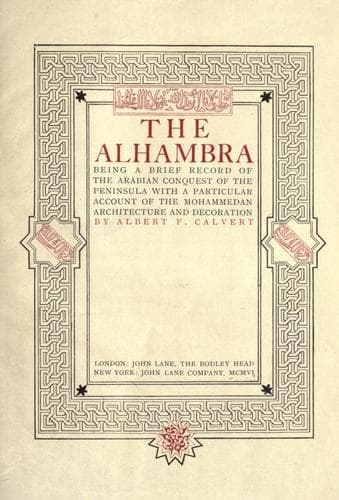
The Alhambra: being a brief record of the Arabian conquest of the Peninsula with a particular account of the Mohammedan architecture and decorationCalvert, Albert Frederick
Islamic
The Alhambra: being a brief record of the Arabian conquest of the Peninsula with a particular account of the Mohammedan architecture and decoration
In point of situation, the royal villa, or “pleasaunce,” of the Moorish
Kings of Granada, is fully equal to the site chosen for the erection of
the Alhambra. It stands upon an acclivity, behind which are lovely
gardens, extensively timbered with trees of gigantic growth, where
nightingales sing themselves hoarse in shrubberies rendered luxuriant by
soft, refreshing rivulets. In the Generalife may be seen many Cufic
inscriptions: the white tiles with golden scrolls occur nowhere else.
The _Cuarto Real_ and its beautiful gardens once belonged to Dalahorra,
mother of “Muley Hasen,” and within three months of the capitulation of
Granada they were ceded to Alonzo de Valiza, prior of Santa Cruz of
Avila. Ford made an abstract of the original conveyance by which we
learn how Alonzo de Valiza took possession. “Don Alonzo entered the
garden pavilion, affirming loudly that he had made an entry; next, he
opened and shut the door, locking it, and giving the key into the
custody of one _Macafreto_, a well-known householder of Granada; he then
went into the garden, where he severed the branch of a tree and dug up
some earth with a spade, thus exercising his rights of proprietorship.”
Such was the practice of conveyancing in the time of the Moors.
A gateway of the _Cuarto Real_, called _Puerta del Pescado_, is of
Moorish origin, and has three arches.
A picturesque ravine divides the hill of the Alhambra from
the _Sierra del Sol_. Here, the approach is under a high
embowered avenue of fig trees and myrtles. The situation of
the Generalife--_Jennatu-l-’arif_--[13] “The Garden of the
Architect”--proved so entrancing to the Sultán _Isma’il-Ibn Faraj_ that
he was not at rest until he had erected this mountain villa as an abode
for the “Light of his Hareem,” a summer-house, devoted to seclusion,
pleasure, and luxury:
“When free and uncrown’d as the Conqueror rov’d
By the banks of that lake, with his only belov’d,
He saw, in the wreaths she would playfully snatch
From the hedges, a glory his crown could not match,
And preferr’d in his heart the least ringlet that curl’d
Down her exquisite neck to the throne of the world.”
_Tom Moore._
Once again the pages of the Grand Wizír _Ibnu-l-Khattíb_ furnish
testimony at first hand of transactions in which his ungrateful master,
Mohammed V., was involved, and who owed his safety to an accidental
visit to the Generalife.
A conspiracy, having for its object the dethronement of Mohammed V., and
the usurpation of his half-brother, Isma’il, succeeded only too well.
The mother of Isma’il, soon after the death of Yúsuf I., when Mohammed
had rightfully ascended the throne of Granada, created a party against
the monarch, and had attached to her faction all the discontented. The
castle of the Alhambra was surprised in August, 1359. The conspirators,
having liberated Isma’il from his place of confinement, mounted him upon
a horse and proclaimed him through
Public-domain text, read in full here on John Shaqi.
Reviews
Reviews
No reviews yet
Be the first to share your thoughts on this work.
Elsewhere in the archive
Join the Discussion
Join the discussion
Sign in to leave a comment or review.
Sign InorCreate an account