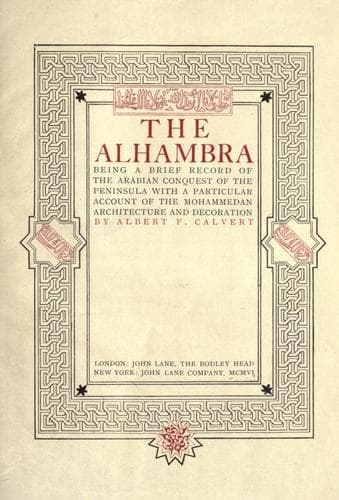
The Alhambra: being a brief record of the Arabian conquest of the Peninsula with a particular account of the Mohammedan architecture and decorationCalvert, Albert Frederick
Islamic
The Alhambra: being a brief record of the Arabian conquest of the Peninsula with a particular account of the Mohammedan architecture and decoration
[Illustration: GROUND PLAN OF THE GENERALIFE AT GRANADA.
A. Advanced parts.
B. The Inner Gallery, commanding a view of the gardens.
C C C C. Terraces and Aqueducts.
D D D, E E. The surrounding country.]
[Illustration: THE GENERALIFE.]
the city as their Sultán. How Mohammed had the good fortune to escape is
thus set forth by his Wizír:
“At the time these events were taking place, the Sultán Mohammed was
absent from the Alhambra, having gone, together with a son of his, to
reside at a delightful country seat close to Granada, called
_Jennatu-l-’arif_, a spot well known for the luxuriance of its trees,
which never admit the rays of the sun,
[Illustration: THE GENERALIFE.]
as well as for the healthfulness of the air, which is continually
refreshed by running streams of limpid water. This garden is only
separated from the royal residence by a high and strong wall, defended
by a deep moat. In this place the Sultán was suddenly awakened by the
clatter of arms, the cries of the assailants, and the beating of drums
in the distance. Not knowing what caused the tumult, Mohammed went out
in the direction of the Alhambra; but, finding that the conspirators
occupied all the avenues, he retraced his steps, and Allah was pleased
to provide for his salvation; for, having mounted a fleet horse, which
was always kept saddled and prepared for him, he galloped off to Guadix,
where he arrived safely the same morning, and presented himself to the
governor of the castle, who was very far from suspecting what had
happened. Mohammed was immediately waited upon by the chief inhabitants
of the place who all swore to protect him, so that he not only reigned
undisturbed over Guadix and its immediate neighbourhood, but soon found
himself at the head of devoted followers who hastened to him from all
parts.”
Meanwhile, his brother, the usurper, despatched an embassy to the King
of Castile, offering to renew the treaty of peace then existing between
the two countries. The Castilian King (Pedro I.), happening then to be
at war with the people of Barcelona, readily assented to the proposal,
and ratified the usurper’s occupation of Granada. Isma’il, however, did
not long enjoy the power he had seized. He was besieged in the Alhambra
by Abú ’Abdillah, afterwards Mohammed VI., taken prisoner, and put to
death, together with his brother, Kayes, in 1360.
The history of the dethroned king, Mohammed V., is particularly
interesting for the reason that he it was who put the finishing touches
to the decoration of the Alhambra, after the work was interrupted by the
assassination of his father, Yúsuf I.
Immediately upon the death of Isma’il, Mohammed VI. was proclaimed king,
and reigned for about two years, at the end of which period, seeing
himself pressed on the one side by the rightful sovereign who burned to
revenge the outrage done to him and recover the throne of his ancestors;
and harassed, on the other hand, by Pedro, King of Castile; he formed
the strange
Public-domain text, read in full here on John Shaqi.
Reviews
Reviews
No reviews yet
Be the first to share your thoughts on this work.
Elsewhere in the archive
Join the Discussion
Join the discussion
Sign in to leave a comment or review.
Sign InorCreate an account