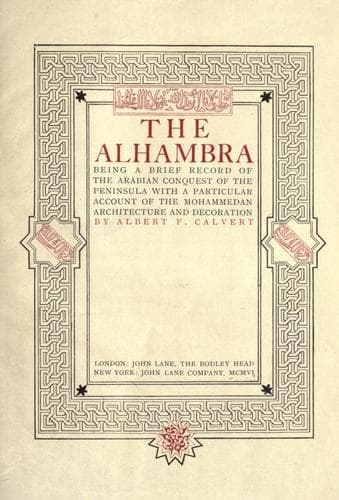
The Alhambra: being a brief record of the Arabian conquest of the Peninsula with a particular account of the Mohammedan architecture and decorationCalvert, Albert Frederick
Islamic
The Alhambra: being a brief record of the Arabian conquest of the Peninsula with a particular account of the Mohammedan architecture and decoration
The Acequia Court reminds the observer of the Court of the Fishpond; or
of Myrtles, in the Alhambra. Although of no such great dimensions,
similar arcades, galleries, and fountains, are here seen in profusion.
The slender pillars and gossamer-perforated fabrics are, as in the case
of the greater Palace, like nothing so much as our conception of
fairy-work, rather a dream of beauty than the production of human hands.
LA CASA DEL CARBON--THE CHARCOAL HOUSE.
Halfway down the Zacatin, which was, in Moorish times, the bazaar, or
market, of Granada--then alive with busy silversmiths, and with silk
merchants, who offered the most wondrous productions of the loom--stands
whatever remains of the elegant palace known as the Charcoal House, from
having been appropriated to the sale of that commonplace article. The
edifice, until recent times, bore the name by which it had been known
for centuries, viz.: _La Casa del Gallo de Viento_--The Weather-cock
House.
There is a tradition that the palace was built by Bàdìs Ibn Hàbus, the
third Sultàn of Granada of the Zeyrite dynasty, about 1070 A.D., by
whose direction a vane was made in the
[Illustration: THE ACEQUIA COURT, IN THE GENERALIFE.]
[Illustration: THE ACEQUIA COURT IN THE GENERALIFE, FROM THE MAIN
ENTRANCE.]
[Illustration: THE ACEQUIA COURT IN THE GENERALIFE.]
[Illustration: A CORNER OF THE ACEQUIA COURT IN THE GENERALIFE.]
[Illustration: CYPRESS COURT IN THE GENERALIFE.]
[Illustration: GALLERY OF THE ACEQUIA COURT IN THE GENERALIFE.]
shape of a warrior mounted on a steed, with a shield and levelled spear
in his hands. _Al-makkarì_ tells us that he read in the manuscript of a
learned Moorish historian the following anecdote concerning it: “I was
told by the _Faquih Sìdì Hasan_ ... that he was present at the taking
down of the talisman, known as the weather-cock, which once stood on the
top of the old _Kassabah_--fortified enclosure--at Granada, and was
removed on account of the improvements and repairs about to be made in
that building. I saw it with my own eyes; it was of heptagonal shape,
and bore the following Arabic inscription in verse:
“The palace at fair Granada presents to the eye of the observer a
talisman turning round with the succession of time.
“The horseman on its weather-cock, although a solid body, turns with
every wind.
“This to the wise man, reveals many a mystery.
“Indeed, after subsisting a short time, a calamity shall come which
shall ruin both the palace and its owner.
“Thus shall Andalus vanish one day!”
Public-domain text, read in full here on John Shaqi.
Reviews
Reviews
No reviews yet
Be the first to share your thoughts on this work.
Elsewhere in the archive
Join the Discussion
Join the discussion
Sign in to leave a comment or review.
Sign InorCreate an account