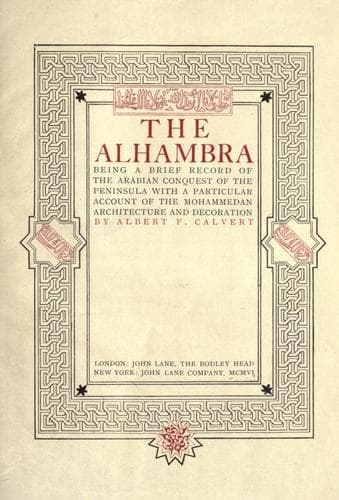
The Alhambra: being a brief record of the Arabian conquest of the Peninsula with a particular account of the Mohammedan architecture and decorationCalvert, Albert Frederick
Islamic
The Alhambra: being a brief record of the Arabian conquest of the Peninsula with a particular account of the Mohammedan architecture and decoration
Upon the naked summit of the height above the Generalife are some
shapeless ruins, known as the _Silla del Moro_--the seat of the
Moor--said to have been a point of observation of Boabdil, the Unlucky,
while an insurrection was raging in the city below. An apocryphal
portrait of Boabdil, _El Rey Chico_, hangs in the picture gallery of the
Generalife. The face is mild, handsome, and somewhat melancholy, with a
fair complexion and yellow hair. Other indifferent paintings are to be
seen in the gallery, including those of Ferdinand and Isabella. The
genealogical tree of the Marquis of Campotejar of the Grimalda Gentili
family, better known as Pallavicini, of Genoa, is exhibited in the
picture gallery. The villa now belongs to the Marquis, who, being an
absentee, has placed the palace under the care of an _administrador_.
The founder of the Grimaldi family was one Cidi Aya, a Moorish prince,
who was of service to Ferdinand on the expulsion of the Moors, at which
time he became a Christian knight under the name of Don Pedro. His son,
Don Aixa, is represented in the pedigree hanging in the picture gallery,
trampling, like a renegade, on the ensigns of his ancestors. An enormous
weapon, traditionally known as “The Sword of Boabdil,” having a
beautifully enamelled sheath enriched with gold and silver work, is
preserved in the office of the Italian Consulate at Granada.
The decorations of the Generalife are in no respect inferior to those of
the Alhambra; the wood-work is of _nogal_, or Spanish chestnut, and,
where it has not been wantonly injured, is in its original condition. It
is thought that the Moors preserved their wood-work by coating it with a
substance called
[Illustration: FRONT VIEW OF THE PORTICO OF THE GENERALIFE.]
[Illustration: A CEILING IN THE GENERALIFE.]
[Illustration: THE GENERALIFE.
ENTRANCE TO THE GALLERY OF RETRATOS (PORTRAIT GALLERY).]
[Illustration: THE GENERALIFE.
GALLERY IN THE ACEQUIA COURT.]
_colle_ and _almaqu_, _i.e._, size mixed with a reddish earth, and
rendered obnoxious to insects. The black lines which ornament the
wood-work are believed to have been traced with a hot iron.
[Illustration: GALLERY IN THE GENERALIFE.]
Nothing can exceed the symmetry of the Portico of the Generalife. The
columns are of white marble, surmounted by arches and arabesques. The
inscription, many times repeated, and running along the whole front of
the Portico, is that which occurs so frequently in the Alhambra, “There
is no conqueror but God.” The dado has a very rich effect, the colours
being black, blue, gold, scarlet, and green.
The transverse section of the Royal Villa, shown in the plate at p. 411,
gives an idea of the beauty of the interior decorations. The ceiling of
the chief apartment is a _chef-d’œuvre_ of Arabian workmanship; the
exquisite delicacy and consummate taste displayed by the artist must be
seen before a full appreciation can be acquired. The ceiling is
delineated at p. 425.
Public-domain text, read in full here on John Shaqi.
Reviews
Reviews
No reviews yet
Be the first to share your thoughts on this work.
Elsewhere in the archive
Join the Discussion
Join the discussion
Sign in to leave a comment or review.
Sign InorCreate an account