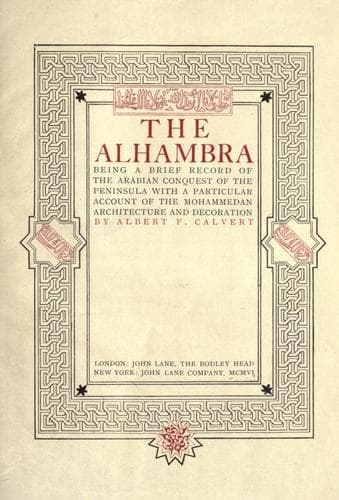
The Alhambra: being a brief record of the Arabian conquest of the Peninsula with a particular account of the Mohammedan architecture and decorationCalvert, Albert Frederick
Islamic
The Alhambra: being a brief record of the Arabian conquest of the Peninsula with a particular account of the Mohammedan architecture and decoration
The first collection of romantic Spanish ballads, that of Ferdinand de
Castillo, was published so early as 1510; and, as the title of the book
declares that the volume contains the ancient and modern songs of the
Troubadours of Spain, it is clear that a certain number of the pieces
were then considered ancient. There are not wanting circumstances which
would seem to establish for many of the Spanish ballads a claim to
antiquity much higher than is to be inferred from this date; for, in the
_General Chronicle of Spain_, which was compiled in the fourteenth
century at the instance of Alfonso the Wise, allusions are constantly
made to the popular songs of the minstrels, or _Joglares_. One thing is
certain, that the Spaniards are in possession of the oldest, as well as
the largest, collection of _popular_ ballad poetry, properly so called,
than is to be found in the literature of any other European nation; and
Lockhart very pertinently puts the enquiry, “Had there been published at
London, in the reign of our eighth Henry, a vast collection of English
ballads about the wars of the Plantagenets, what illustration and
annotation would not that collection have received ere now?”
It is fair, perhaps, to conclude that a great and remarkable influence
was exerted over Spanish thought and feeling--and, therefore, over
Spanish language and poetry--by the influx of those Oriental tribes who
occupied, for long centuries, the fairest provinces of Spain;
particularly when it is remembered that the Christian youth studied
freely and honourably at the feet of Jewish and Mohammedan philosophers.
Throughout the oldest Spanish ballads there breathes a spirit of charity
towards their Moorish enemies, for, in spite of adverse faith, in spite
of adverse interests, they had much in common. Loves, and sports--nay,
sometimes their haughtiest recollections--were in common; and even their
heroes were the same: Bernardo del Carpio, Fernan Gonzalez, the Cid
himself, had, at some period of their lives, fought beneath the standard
of the Crescent, and the minstrels of either nation had equal pride in
the celebration of their prowess. Even in the ballads most exclusively
devoted to the records of feats of Spanish heroism, it is quite common
to find some handsome compliment paid to the Moors. And when, at a later
period, the conquest of Granada had mingled the Spaniards with the
persons and manners of the Moors, the Spanish ballad-mongers still
celebrated the achievements of their Saracen rivals; and the compliment
towards “the Knights of Granada, gentlemen, albeit Moors,”
_Caballeros Granadinos_
_Aunque Moros hijos d’algo_,
must have been extremely gratifying to the defeated.
Public-domain text, read in full here on John Shaqi.
Reviews
Reviews
No reviews yet
Be the first to share your thoughts on this work.
Elsewhere in the archive
Join the Discussion
Join the discussion
Sign in to leave a comment or review.
Sign InorCreate an account