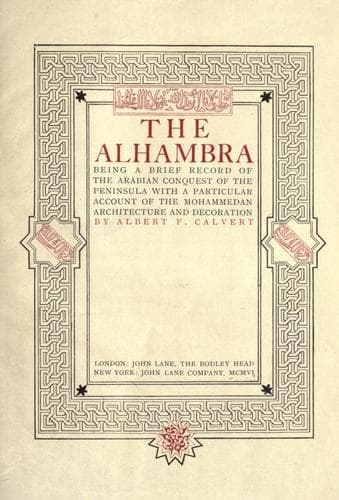
The Alhambra: being a brief record of the Arabian conquest of the Peninsula with a particular account of the Mohammedan architecture and decorationCalvert, Albert Frederick
Islamic
The Alhambra: being a brief record of the Arabian conquest of the Peninsula with a particular account of the Mohammedan architecture and decoration
The ballads of Moorish origin are rather of the romantic than the
historical class. They were sung in the villages of Andalusia in either
language, but to the same tunes, and listened to with equal pleasure by
Mussulman and Christian. In these strains, says Lockhart, whatever
merits or demerits they may possess, they present a lively picture of
the life of the Arabian Spaniard. We see him as he was in reality, “like
steel among weapons--like wax among women.”
There came, indeed, a time when the fondness of the Spaniards for their
Moorish ballads was made a matter of reproach; but this was not till
long after the period when Spanish bravery had recovered the last
fragments of the Peninsula from the Moslem.
The greater part of the Moorish ballads refer to the period immediately
preceding, and at the time of the downfall of the throne of Granada. The
amours of that splendid court; the bull fights, and other spectacular
displays in which its lords and ladies delighted no less than those of
the Christian courts of Spain; the feuds of the two great families of
the Zegris and the Abencerrages, which contributed so largely to the
ruin of the Moorish cause; and the incidents of the last war, in which
the power of the Moslem was entirely overthrown by the arms of Ferdinand
and Isabella.
The ballad, composed on the departure from Granada of the Moors, is a
specimen of romantic minstrelsy which has never depended on historic
truth. The allusion in the third stanza to the old white beard of the
Moorish king seems to favour the conjecture that “Muley Hasen,” and not
his son Boabdil, surrendered the keys of the fortress.
“THE FLIGHT FROM GRANADA.”
There was crying in Granada when the sun was going down--
Some calling on the Trinity--some calling on Mahoun!
Here passed away the Korán--there in the Cross was borne--
And here was heard the Christian bell, and there the Moorish horn;
_Te Deum Laudamus!_ was up the Alcala sung:
Down from th’ Alhambra’s minarets were all the crescents flung;
The arms thereon of Aragon they with Castile’s display;
One king comes in in triumph--one weeping goes away!
Thus cried the weeper, while his hands his old white beard did tear,
“Farewell, farewell, Granada! thou city without peer!
Woe, woe thou pride of heathendom! seven hundred years and more
Have gone since first the faithful thy royal sceptre bore!
“Thou wert the happy mother of a high renownéd race;
Within thee dwelt a haughty line that now go from their place;
Within thee fearless knights did dwell, who fought with mickle glee
The enemies of proud Castile--the bane of Christientie!
“The mother of fair dames wert thou, of truth and beauty rare,
Into whose arms did courteous knights for solace sweet repair;
For whose dear sakes the gallants of Afric made display
Of might in joust and battle on many a bloody day!
Public-domain text, read in full here on John Shaqi.
Reviews
Reviews
No reviews yet
Be the first to share your thoughts on this work.
Elsewhere in the archive
Join the Discussion
Join the discussion
Sign in to leave a comment or review.
Sign InorCreate an account