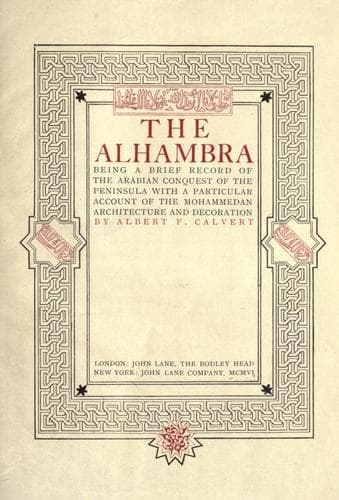
The Alhambra: being a brief record of the Arabian conquest of the Peninsula with a particular account of the Mohammedan architecture and decorationCalvert, Albert Frederick
Islamic
The Alhambra: being a brief record of the Arabian conquest of the Peninsula with a particular account of the Mohammedan architecture and decoration
“No Spaniard could have written it with more conscientiousness and
enthusiasm.... All the plates are exquisite, and, as the historical
narrative leaves nothing to be desired, the book constitutes a most
opportune literary jewel.”--_El Defensor_ (Granada).
FOOTNOTES:
[1] Formerly _Illiberis_, the Roman town at the foot of the Sierra
Nevada, about six miles from Granada.
[2] _Kilaat Al-hamra_, the red castle.
[3] _Sheníl_ is the _Singilis_ of the Romans. The name of another
“considerable stream” of Granada--the Darro--is derived from _Hadároh_
in Arabic, probably from _Hadár_, which means the rapidity with which
a swollen river comes down from the mountains; a description well
defining the character of the river Darro, which rushes down the
hill-side and comes boiling along its channel at the foot.
[4] The Moors were not finally expelled from Spain until 1610.
[5] It is a little singular that not only the Arab Governor of North
Africa, Viceroy of the Caliph Welid, who despatched from Ceuta the
invading forces under Tarif and Geb-al-Tarik, bore this name; but,
eight centuries afterwards, the gallant hero who alone was able to
rouse the lethargic Boabdil from his stupor to make a last stand
for Islam, bore it also. The name of Musa of Granada must always be
honoured as that of a fearless knight who, disdaining to surrender,
at the last rode through a score of Christian knights, killing many
of them; and, when too weak to continue the struggle, threw himself,
encumbered with armour, into the river Xenil, thus meeting his end.
[6] The Conde de Tendilla, the first Alcayde of the Alhambra, raised
the tomb to be seen in the Cathedral of Granada, where lies Fernando
“the Good,” of Talavera, first Archbishop of Granada, who died 14th
May, 1507. The Count inscribed it “_Amicus Amico_.”
[7] “Boabdil” is a corruption of Abu’ Abdillah, or Boabdila, as the
Spaniards pronounced the name. He was, in addition to his sobriquet
of “the Unlucky,” also called As-sagher, or “the lesser” (el rey
chico), to distinguish him from his uncle and successor, Abu’ Abdillah
(Mohammed XII.)
[8] In the Hall of the Ambassadors, or Golden Saloon, is an inscription
referring to this:--“The best praise be given to Allah! I will remove
all the effects of an Evil Eye upon our master Yúsuf.”
[9] Edited by Pablo Lozano. The antiquities and history of the Moorish
domination in Spain remained unheeded until representations were made
that research and accurate delineation would alone make their monuments
intelligible. The Royal Academy of St. Ferdinand was commissioned
to make drawings of the Palace of the Alhambra and of the Mosque of
Córdova. The result of their labours were published at Madrid, in
1780, in a folio volume entitled as above, with sixteen plates of
Arabic designs, accompanied by a few pages of letterpress. It is an
exceedingly rare volume.
[10] Madrid, 1780 (already referred to).
Public-domain text, read in full here on John Shaqi.
Reviews
Reviews
No reviews yet
Be the first to share your thoughts on this work.
Elsewhere in the archive
Join the Discussion
Join the discussion
Sign in to leave a comment or review.
Sign InorCreate an account