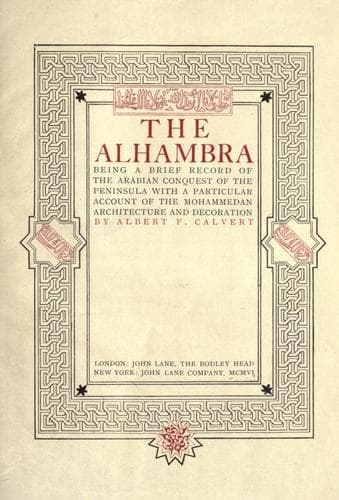
The Alhambra: being a brief record of the Arabian conquest of the Peninsula with a particular account of the Mohammedan architecture and decorationCalvert, Albert Frederick
Islamic
The Alhambra: being a brief record of the Arabian conquest of the Peninsula with a particular account of the Mohammedan architecture and decoration
[11] The Moorish fortress of Alhama was rightly regarded as one of the
two “Keys” of Granada, Loja--the Lôsha of the Moors--ranking as the
other. Loja was besieged by Ferdinand and Isabella, and captured, in
1488, after thirty-four days’ investment; chiefly, it is said, by the
aid of English archers under Earl Rivers, son of Anthony Wydeville,
brother to Elizabeth, Queen of our Edward IV. Alhama had fallen 28th
February, 1482, and its loss is the subject of the ballad referred to.
[12] Such, at least, are the reasons given for the abandonment of the
gigantic blocks of stone which were heaped up by Charles to rival the
unsurpassable. It is said, however, that repeated shocks of earthquake
frightened him out of the enterprise.
[13] _Al-’arif_, in Spanish, _Alarife_, means “an inspector of public
works”; and, according to Ibnu-l-Khattíb, the Grand Wizír of Yúsuf I.,
and of his son, Mohammed V., the site of the Generalife belonged to a
person of that profession before it passed into the hands of the Sultán
_Isma’il-Ibn-Faraj_, who, in A.D. 1320, bought the land
for a large sum, and built the palace as a delightful retreat from the
cares of State.
[14] Acequia Court. The Arab word is _Sákiyyah_, whence the Spanish
_Acequia_ is derived. The word means an artificial or diverted running
stream in a garden; or, a canal for the purpose of irrigation.
Public-domain text, read in full here on John Shaqi.
Reviews
Reviews
No reviews yet
Be the first to share your thoughts on this work.
Elsewhere in the archive
Join the Discussion
Join the discussion
Sign in to leave a comment or review.
Sign InorCreate an account