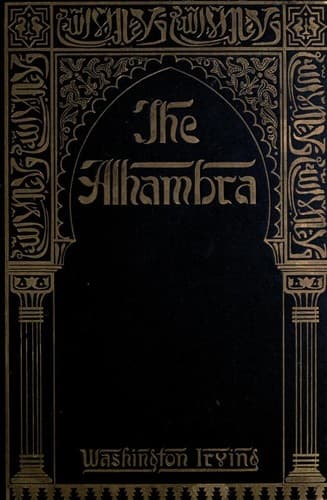
Verhalen over het gebouwencomplex in Granada, dat eigendom was van de laatste islamitische vorsten in Spanje.
The astrologer immediately set to work to gratify the wishes of the
monarch. He caused a great tower to be erected upon the top of the royal
palace, which stood on the brow of the hill of the Albaycin. The tower
was built of stones brought from Egypt, and taken, it is said, from one
of the pyramids. In the upper part of the tower was a circular hall,
with windows looking towards every point of the compass, and before each
window was a table, on which was arranged, as on a chess-board, a mimic
army of horse and foot, with the effigy of the potentate that ruled in
that direction, all carved of wood. To each of these tables there was a
small lance, no bigger than a bodkin, on which were engraved certain
Chaldaic characters. This hall was kept constantly closed, by a gate of
brass, with a great lock of steel, the key of which was in possession of
the king.
On the top of the tower was a bronze figure of a Moorish horseman, fixed
on a pivot, with a shield on one arm, and his lance elevated
perpendicularly. The face of this horseman was towards the city, as if
keeping guard over it; but if any foe were at hand, the figure would
turn in that direction, and would level the lance as if for action.
When this talisman was finished, Aben Habuz was all impatient to try its
virtues, and longed as ardently for an invasion as he had ever sighed
after repose. His desire was soon gratified. Tidings were brought, early
one morning, by the sentinel appointed to watch the tower, that the face
of the bronze horseman was turned towards the mountains of Elvira, and
that his lance pointed directly against the Pass of Lope.
“Let the drums and trumpets sound to arms, and all Granada be put on the
alert,” said Aben Habuz.
“O king,” said the astrologer, “let not your city be disquieted, nor
your warriors called to arms; we need no aid of force to deliver you
from your enemies. Dismiss your attendants, and let us proceed alone to
the secret hall of the tower.”
The ancient Aben Habuz mounted the staircase of the tower, leaning on
the arm of the still more ancient Ibrahim Ebn Abu Ayub. They unlocked
the brazen door and entered. The window that looked towards the Pass of
Lope was open. “In this direction,” said the astrologer, “lies the
danger; approach, O king, and behold the mystery of the table.”
King Aben Habuz approached the seeming chess-board, on which were
arranged the small wooden effigies, when, to his surprise, he perceived
that they were all in motion. The horses pranced and curveted, the
warriors brandished their weapons, and there was a faint sound of drums
and trumpets, and the clang of arms, and neighing of steeds; but all no
louder, nor more distinct, than the hum of the bee, or the summer-fly,
in the drowsy ear of him who lies at noontide in the shade.
Public-domain text, read in full here on John Shaqi.
Reviews
Reviews
No reviews yet
Be the first to share your thoughts on this work.
Elsewhere in the archive
Join the Discussion
Join the discussion
Sign in to leave a comment or review.
Sign InorCreate an account