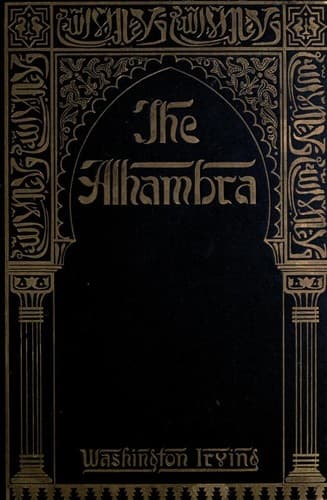
Verhalen over het gebouwencomplex in Granada, dat eigendom was van de laatste islamitische vorsten in Spanje.
While we were supping with our drawcansir friend, we heard the notes of
a guitar, and the click of castanets, and presently a chorus of voices
singing a popular air. In fact, mine host had gathered together the
amateur singers and musicians, and the rustic belles of the
neighborhood, and, on going forth, the courtyard or patio of the inn
presented a scene of true Spanish festivity. We took our seats with mine
host and hostess and the commander of the patrol, under an archway
opening into the court; the guitar passed from hand to hand, but a
jovial shoemaker was the Orpheus of the place. He was a
pleasant-looking fellow, with huge black whiskers; his sleeves were
rolled up to his elbows. He touched the guitar with masterly skill, and
sang a little amorous ditty with an expressive leer at the women, with
whom he was evidently a favorite. He afterwards danced a fandango with a
buxom Andalusian damsel, to the great delight of the spectators. But
none of the females present could compare with mine host’s pretty
daughter, Pepita, who had slipped away and made her toilette for the
occasion, and had covered her head with roses; and who distinguished
herself in a bolero with a handsome young dragoon. We ordered our host
to let wine and refreshment circulate freely among the company, yet,
though there was a motley assembly of soldiers, muleteers, and
villagers, no one exceeded the bounds of sober enjoyment. The scene was
a study for a painter: the picturesque group of dancers, the troopers in
their half military dresses, the peasantry wrapped in their brown
cloaks; nor must I omit to mention the old meagre Alguazil, in a short
black cloak, who took no notice of anything going on, but sat in a
corner diligently writing by the dim light of a huge copper lamp, that
might have figured in the days of Don Quixote.
The following morning was bright and balmy, as a May morning ought to
be, according to the poets. Leaving Arahal at seven o’clock, with all
the posada at the door to cheer us off, we pursued our way through a
fertile country, covered with grain and beautifully verdant; but which
in summer, when the harvest is over and the fields parched and brown,
must be monotonous and lonely; for, as in our ride of yesterday, there
were neither houses nor people to be seen. The latter all congregate in
villages and strongholds among the hills, as if these fertile plains
were still subject to the ravages of the Moor.
Public-domain text, read in full here on John Shaqi.
Reviews
Reviews
No reviews yet
Be the first to share your thoughts on this work.
Join the Discussion
Join the discussion
Sign in to leave a comment or review.
Sign InorCreate an account