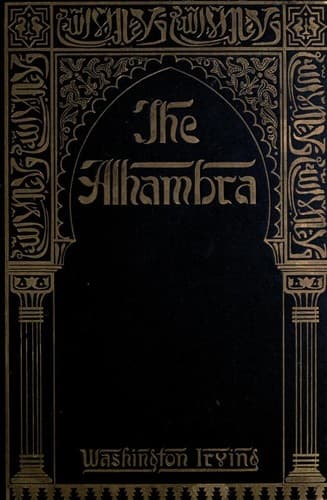
Verhalen over het gebouwencomplex in Granada, dat eigendom was van de laatste islamitische vorsten in Spanje.
The presence of this fascinating little being spread a new charm about
the Alhambra, and seemed to be in unison with the place. While the count
and countess, with the chaplain or secretary, were playing their game of
tresillo under the vestibule of the Court of Lions, she, attended by
Dolores, who acted as her maid of honor, would sit by one of the
fountains, and accompanying herself on the guitar, would sing some of
those popular romances which abound in Spain, or, what was still more to
my taste, some traditional ballad about the Moors.
Never shall I think of the Alhambra without remembering this lovely
little being, sporting in happy and innocent girlhood in its marble
halls, dancing to the sound of the Moorish castanets, or mingling the
silver warbling of her voice with the music of its fountains.
RELICS AND GENEALOGIES
If I had been pleased and interested by the count and his family, as
furnishing a picture of a Spanish domestic life, I was still more so
when apprised of historical circumstances which linked them with the
heroic times of Granada. In fact, in this worthy old cavalier, so
totally unwarlike, or whose deeds in arms extended, at most, to a war on
swallows and martlets, I discovered a lineal descendant and actual
representative of Gonsalvo of Cordova, “The Grand Captain,” who won some
of his brightest laurels before the walls of Granada, and was one of the
cavaliers commissioned by Ferdinand and Isabella to negotiate the terms
of surrender; nay, more, the count was entitled, did he choose it, to
claim remote affinity with some of the ancient Moorish princes, through
a scion of his house, Don Pedro Venegas, surnamed the Tornadizo; and by
the same token his daughter, the fascinating little Carmen, might claim
to be rightful representative of the princess Cetimerien or the
beautiful Lindaraxa.[17]
Understanding from the count that he had some curious relics of the
Conquest, preserved in his family archives, I accompanied him early one
morning down to his palace in Granada to examine them. The most
important of these relics was the sword of the Grand Captain; a weapon
destitute of all ostentatious ornament, as the weapons of great generals
are apt to be, with a plain hilt of ivory and a broad thin blade. It
might furnish a comment on hereditary honors, to see the sword of the
Grand Captain legitimately declined into such feeble hands.
The other relics of the Conquest were a number of espingardas or muskets
of unwieldy size and ponderous weight, worthy to rank with those
enormous two-edged swords preserved in old armories, which look like
relics from the days of the giants.
Public-domain text, read in full here on John Shaqi.
Reviews
Reviews
No reviews yet
Be the first to share your thoughts on this work.
Elsewhere in the archive
Join the Discussion
Join the discussion
Sign in to leave a comment or review.
Sign InorCreate an account