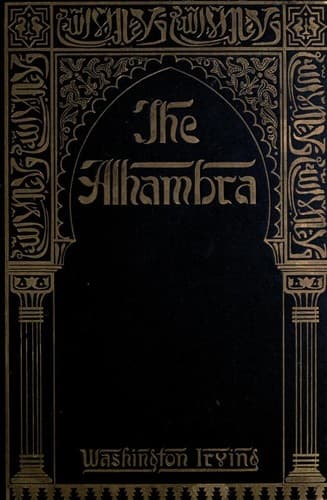
Verhalen over het gebouwencomplex in Granada, dat eigendom was van de laatste islamitische vorsten in Spanje.
Beside other hereditary honors, I found the old count was Alferez mayor,
or grand standard-bearer, in which capacity he was entitled to bear the
ancient standard of Ferdinand and Isabella, on certain high and solemn
occasions, and to wave it over their tombs. I was shown also the
caparisons of velvet, sumptuously embroidered with gold and silver, for
six horses, with which he appeared in state when a new sovereign was to
be proclaimed in Granada and Seville; the count mounting one of the
horses, and the other five being led by lackeys in rich liveries.
I had hoped to find among the relics and antiquities of the count’s
palace some specimens of the armor and weapons of the Moors of Granada,
such as I had heard were preserved as trophies by the descendants of the
Conquerors; but in this I was disappointed. I was the more curious in
this particular, because an erroneous idea has been entertained by many,
as to the costumes of the Moors of Spain; supposing them to be of the
usual Oriental type. On the contrary, we have it on the authority of
their own writers, that they adopted in many respects the fashions of
the Christians. The turban, especially, so identified in idea with the
Moslem, was generally abandoned, except in the western provinces, where
it continued in use among people of rank and wealth, and those holding
places under government. A woollen cap, red or green, was commonly worn
as a substitute; probably the same kind originating in Barbary, and
known by the name of Tunis or Fez, which at the present day is worn
throughout the East, though generally under the turban. The Jews were
obliged to wear them of a yellow color.
In Murcia, Valencia, and other eastern provinces, men of the highest
rank might be seen in public bare-headed. The warrior king, Aben Hud,
never wore a turban, neither did his rival and competitor Al Hamar, the
founder of the Alhambra. A short cloak called Taylasan, similar to that
seen in Spain in the sixteenth and seventeenth centuries, was worn by
all ranks. It had a hood or cape which people of condition sometimes
drew over the head; but the lower class never.
A Moslem cavalier in the thirteenth century, as described by Ibnu Said,
was equipped for war very much in the Christian style. Over a complete
suit of mail he wore a short scarlet tunic. His helmet was of polished
steel; a shield was slung at his back; he wielded a huge spear with a
broad point, sometimes a double point. His saddle was cumbrous,
projecting very much in front and in rear, and he rode with a banner
fluttering behind him.
Public-domain text, read in full here on John Shaqi.
Reviews
Reviews
No reviews yet
Be the first to share your thoughts on this work.
Elsewhere in the archive
Join the Discussion
Join the discussion
Sign in to leave a comment or review.
Sign InorCreate an account