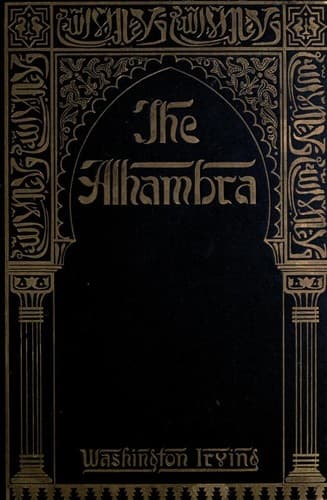
Verhalen over het gebouwencomplex in Granada, dat eigendom was van de laatste islamitische vorsten in Spanje.
“No, Señor, God be thanked! but my grandfather, the tailor, knew several
persons that had seen it, for it went about much oftener in his time
than at present; sometimes in one shape, sometimes in another. Everybody
in Granada has heard of the Belludo, for the old women and the nurses
frighten the children with it when they cry. Some say it is the spirit
of a cruel Moorish king, who killed his six sons and buried them in
these vaults, and that they hunt him at nights in revenge.”
I forbear to dwell upon the marvellous details given by the
simple-minded Mateo about this redoubtable phantom, which has, in fact,
been time out of mind a favorite theme of nursery tales and popular
tradition in Granada, and of which honorable mention is made by an
ancient and learned historian and topographer of the place.
Leaving this eventful pile, we continued our course, skirting the
fruitful orchards of the Generalife, in which two or three nightingales
were pouring forth a rich strain of melody. Behind these orchards we
passed a number of Moorish tanks, with a door cut into the rocky bosom
of the hill, but closed up. These tanks, Mateo informed me, were
favorite bathing-places of himself and his comrades in boyhood, until
frightened away by a story of a hideous Moor, who used to issue forth
from the door in the rock to entrap unwary bathers.
Leaving these haunted tanks behind us, we pursued our ramble up a
solitary mule-path winding among the hills, and soon found ourselves
amidst wild and melancholy mountains, destitute of trees, and here and
there tinted with scanty verdure. Everything within sight was severe and
sterile, and it was scarcely possible to realize the idea that but a
short distance behind us was the Generalife, with its blooming orchards
and terraced gardens, and that we were in the vicinity of delicious
Granada, that city of groves and fountains. But such is the nature of
Spain; wild and stern the moment it escapes from cultivation; the desert
and the garden are ever side by side.
The narrow defile up which we were passing is called, according to
Mateo, _el Barranco de la tinaja_, or the ravine of the jar, because a
jar full of Moorish gold was found here in old times. The brain of poor
Mateo was continually running upon these golden legends.
“But what is the meaning of the cross I see yonder upon a heap of
stones, in that narrow part of the ravine?”
“Oh, that’s nothing--a muleteer was murdered there some years since.”
“So then, Mateo, you have robbers and murderers even at the gates of the
Alhambra?”
“Not at present, Señor; that was formerly, when there used to be many
loose fellows about the fortress; but they’ve all been weeded out. Not
but that the gypsies who live in caves in the hill-sides, just out of
the fortress, are many of them fit for anything; but we have had no
murder about here for a long time past. The man who murdered the
muleteer was hanged in the fortress.”
Public-domain text, read in full here on John Shaqi.
Reviews
Reviews
No reviews yet
Be the first to share your thoughts on this work.
Elsewhere in the archive
Join the Discussion
Join the discussion
Sign in to leave a comment or review.
Sign InorCreate an account