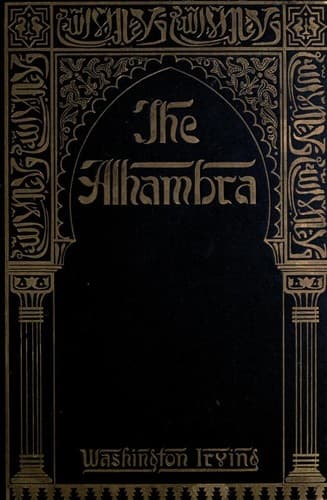
Verhalen over het gebouwencomplex in Granada, dat eigendom was van de laatste islamitische vorsten in Spanje.
Our path continued up the barranco, with a bold, rugged height to our
left, called the “Silla del Moro,” or Chair of the Moor, from the
tradition already alluded to, that the unfortunate Boabdil fled thither
during a popular insurrection, and remained all day seated on the rocky
summit, looking mournfully down on his factious city.
We at length arrived on the highest part of the promontory above
Granada, called the mountain of the sun. The evening was approaching;
the setting sun just gilded the loftiest heights. Here and there a
solitary shepherd might be descried driving his flock down the
declivities, to be folded for the night; or a muleteer and his lagging
animals, threading some mountain path to arrive at the city gates before
nightfall.
Presently the deep tones of the Cathedral bell came swelling up the
defiles, proclaiming the hour of “oration” or prayer. The note was
responded to from the belfry of every church, and from the sweet bells
of the convents among the mountains. The shepherd paused on the fold of
the hill, the muleteer in the midst of the road; each took off his hat
and remained motionless for a time, murmuring his evening prayer. There
is always something pleasingly solemn in this custom, by which, at a
melodious signal, every human being throughout the land unites at the
same moment in a tribute of thanks to God for the mercies of the day. It
spreads a transient sanctity over the land, and the sight of the sun
sinking in all his glory adds not a little to the solemnity of the
scene.
In the present instance the effect was heightened by the wild and lonely
nature of the place. We were on the naked and broken summit of the
haunted mountain of the sun, where ruined tanks and cisterns, and the
mouldering foundations of extensive buildings, spoke of former
populousness, but where all was now silent and desolate.
As we were wandering about among these traces of old times, we came to a
circular pit, penetrating deep into the bosom of the mountain; which
Mateo pointed out as one of the wonders and mysteries of the place. I
supposed it to be a well dug by the indefatigable Moors, to obtain their
favorite element in its greatest purity. Mateo, however, had a different
story, and one much more to his humor. According to a tradition, in
which his father and grandfather firmly believed, this was an entrance
to the subterranean caverns of the mountain, in which Boabdil and his
court lay bound in magic spell, and whence they sallied forth at night,
at allotted times, to revisit their ancient abodes.
Public-domain text, read in full here on John Shaqi.
Reviews
Reviews
No reviews yet
Be the first to share your thoughts on this work.
Elsewhere in the archive
Join the Discussion
Join the discussion
Sign in to leave a comment or review.
Sign InorCreate an account