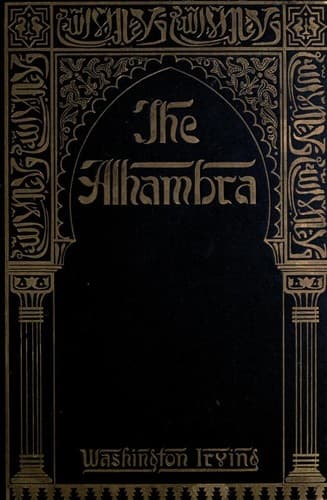
Verhalen over het gebouwencomplex in Granada, dat eigendom was van de laatste islamitische vorsten in Spanje.
Honest Peregil thus saw himself unexpectedly saddled with an infidel
guest, but he was too humane to refuse a night’s shelter to a
fellow-being in so forlorn a plight; so he conducted the Moor to his
dwelling. The children, who had sallied forth open-mouthed as usual on
hearing the tramp of the donkey, ran back with affright when they beheld
the turbaned stranger, and hid themselves behind their mother. The
latter stepped forth intrepidly, like a ruffling hen before her brood
when a vagrant dog approaches.
“What infidel companion,” cried she, “is this you have brought home at
this late hour, to draw upon us the eyes of the inquisition?”
“Be quiet, wife,” replied the Gallego; “here is a poor sick stranger,
without friend or home; wouldst thou turn him forth to perish in the
streets?”
The wife would still have remonstrated, for although she lived in a
hovel, she was a furious stickler for the credit of her house; the
little water-carrier, however, for once was stiffnecked, and refused to
bend beneath the yoke. He assisted the poor Moslem to alight, and spread
a mat and a sheep-skin for him, on the ground, in the coolest part of
the house; being the only kind of bed that his poverty afforded.
In a little while the Moor was seized with violent convulsions, which
defied all the ministering skill of the simple water-carrier. The eye of
the poor patient acknowledged his kindness. During an interval of his
fits he called him to his side, and addressing him in a low voice, “My
end,” said he, “I fear is at hand. If I die, I bequeath you this box as
a reward for your charity”: so saying, he opened his albornoz, or cloak,
and showed a small box of sandal-wood, strapped round his body. “God
grant, my friend,” replied the worthy little Gallego, “that you may live
many years to enjoy your treasure, whatever it may be.” The Moor shook
his head; he laid his hand upon the box, and would have said something
more concerning it, but his convulsions returned with increasing
violence, and in a little while he expired.
The water-carrier’s wife was now as one distracted. “This comes,” said
she, “of your foolish good-nature, always running into scrapes to oblige
others. What will become of us when this corpse is found in our house?
We shall be sent to prison as murderers; and if we escape with our
lives, shall be ruined by notaries and alguazils.”
Poor Peregil was in equal tribulation, and almost repented himself of
having done a good deed. At length a thought struck him. “It is not yet
day,” said he; “I can convey the dead body out of the city, and bury it
in the sands on the banks of the Xenil. No one saw the Moor enter our
dwelling, and no one will know anything of his death.”
So said, so done. The wife aided him; they rolled the body of the
unfortunate Moslem in the mat on which he had expired, laid it across
the ass, and Peregil set out with it for the banks of the river.
Public-domain text, read in full here on John Shaqi.
Reviews
Reviews
No reviews yet
Be the first to share your thoughts on this work.
Elsewhere in the archive
Join the Discussion
Join the discussion
Sign in to leave a comment or review.
Sign InorCreate an account