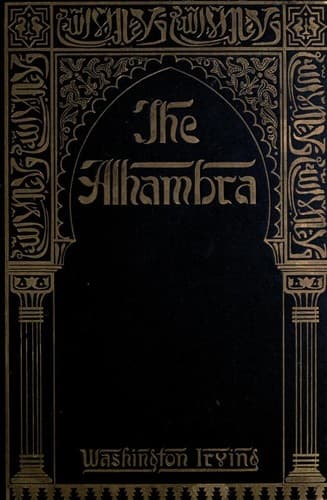
Verhalen over het gebouwencomplex in Granada, dat eigendom was van de laatste islamitische vorsten in Spanje.
Thus there was a perpetual feud and heart-burning between the
captain-general and the governor, the more virulent on the part of the
latter, inasmuch as the smallest of two neighboring potentates is always
the most captious about his dignity. The stately palace of the
captain-general stood in the Plaza Nueva, immediately at the foot of the
hill of the Alhambra; and here was always a bustle and parade of guards,
and domestics, and city functionaries. A beetling bastion of the
fortress overlooked the palace and public square in front of it; and on
this bastion the old governor would occasionally strut backwards and
forwards, with his toledo girded by his side, keeping a wary eye down
upon his rival, like a hawk reconnoitring his quarry from his nest in a
dry tree.
Whenever he descended into the city, it was in grand parade; on
horseback, surrounded by his guards; or in his state coach, an ancient
and unwieldy Spanish edifice of carved timber and gilt leather, drawn by
eight mules, with running footmen, outriders, and lackeys; on which
occasions he flattered himself he impressed every beholder with awe and
admiration as vicegerent of the king; though the wits of Granada,
particularly those who loitered about the palace of the captain-general,
were apt to sneer at his petty parade, and, in allusion to the vagrant
character of his subjects, to greet him with the appellation of “the
king of the beggars.” One of the most fruitful sources of dispute
between these two doughty rivals was the right claimed by the governor
to have all things passed free of duty through the city that were
intended for the use of himself or his garrison. By degrees this
privilege had given rise to extensive smuggling. A nest of
contrabandistas took up their abode in the hovels of the fortress and
the numerous caves in its vicinity, and drove a thriving business under
the connivance of the soldiers of the garrison.
The vigilance of the captain-general was aroused. He consulted his legal
adviser and factotum, a shrewd meddlesome escribano, or notary, who
rejoiced in an opportunity of perplexing the old potentate of the
Alhambra, and involving him in a maze of legal subtilties. He advised
the captain-general to insist upon the right of examining every convoy
passing through the gates of his city, and penned a long letter for him
in vindication of the right. Governor Manco was a straight-forward
cut-and-thrust old soldier, who hated an escribano worse than the devil,
and this one in particular worse than all other escribanos.
“What!” said he, curling up his moustaches fiercely, “does the
captain-general set his man of the pen to practise confusions upon me?
I’ll let him see an old soldier is not to be baffled by schoolcraft.”
Public-domain text, read in full here on John Shaqi.
Reviews
Reviews
No reviews yet
Be the first to share your thoughts on this work.
Elsewhere in the archive
Join the Discussion
Join the discussion
Sign in to leave a comment or review.
Sign InorCreate an account