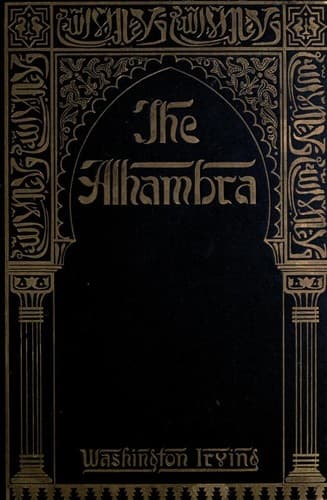
Verhalen over het gebouwencomplex in Granada, dat eigendom was van de laatste islamitische vorsten in Spanje.
He seized his pen and scrawled a short letter in a crabbed hand, in
which, without deigning to enter into argument, he insisted on the right
of transit free of search, and denounced vengeance on any custom-house
officer who should lay his unhallowed hand on any convoy protected by
the flag of the Alhambra. While this question was agitated between the
two pragmatical potentates, it so happened that a mule laden with
supplies for the fortress arrived one day at the gate of Xenil, by which
it was to traverse a suburb of the city on its way to the Alhambra. The
convoy was headed by a testy old corporal, who had long served under the
governor, and was a man after his own heart; as rusty and stanch as an
old Toledo blade.
As they approached the gate of the city, the corporal placed the banner
of the Alhambra on the pack-saddle of the mule, and drawing himself up
to a perfect perpendicular, advanced with his head dressed to the front,
but with the wary side-glance of a cur passing through hostile ground
and ready for a snap and a snarl.
“Who goes there?” said the sentinel at the gate.
“Soldier of the Alhambra!” said the corporal, without turning his head.
“What have you in charge?”
“Provisions for the garrison.”
“Proceed.”
The corporal marched straight forward, followed by the convoy, but had
not advanced many paces before a posse of custom-house officers rushed
out of a small toll-house.
“Hallo there!” cried the leader. “Muleteer, halt, and open those
packages.”
The corporal wheeled round and drew himself up in battle-array. “Respect
the flag of the Alhambra,” said he; “these things are for the governor.”
“A figo for the governor and a figo for his flag. Muleteer, halt, I
say.”
“Stop the convoy at your peril!” cried the corporal, cocking his musket.
“Muleteer, proceed.”
The muleteer gave his beast a hearty thwack; the custom-house officer
sprang forward and seized the halter; whereupon the corporal levelled
his piece and shot him dead.
The street was immediately in an uproar.
The old corporal was seized, and after undergoing sundry kicks, and
cuffs, and cudgellings, which are generally given impromptu by the mob
in Spain as a foretaste of the after penalties of the law, he was loaded
with irons and conducted to the city prison, while his comrades were
permitted to proceed with the convoy, after it had been well rummaged,
to the Alhambra.
Public-domain text, read in full here on John Shaqi.
Reviews
Reviews
No reviews yet
Be the first to share your thoughts on this work.
Elsewhere in the archive
Join the Discussion
Join the discussion
Sign in to leave a comment or review.
Sign InorCreate an account