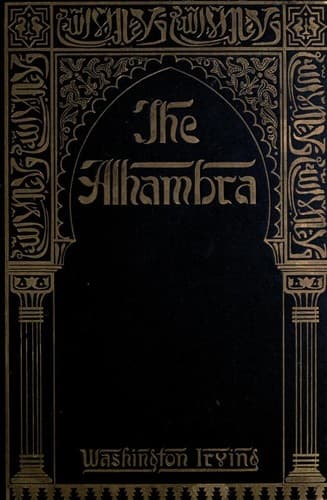
Verhalen over het gebouwencomplex in Granada, dat eigendom was van de laatste islamitische vorsten in Spanje.
The day dawned, the cock crowed, but nobody tapped at the door of the
governor. The sun rose high above the mountain-tops, and glittered in at
his casement, ere the governor was awakened from his morning dreams by
his veteran corporal, who stood before him with terror stamped upon his
iron visage.
“He’s off! he’s gone!” cried the corporal, gasping for breath.
“Who’s off--who’s gone?”
“The soldier--the robber--the devil, for aught I know; his dungeon is
empty, but the door locked: no one knows how he has escaped out of it.”
“Who saw him last?”
“Your handmaid; she brought him his supper.”
“Let her be called instantly.”
Here was new matter of confusion. The chamber of the demure damsel was
likewise empty, her bed had not been slept in: she had doubtless gone
off with the culprit, as she had appeared, for some days past, to have
frequent conversations with him.
This was wounding the old governor in a tender part, but he had scarce
time to wince at it, when new misfortunes broke upon his view. On going
into his cabinet he found his strong box open, the leather purse of the
trooper abstracted and with it a couple of corpulent bags of doubloons.
But how, and which way had the fugitives escaped? An old peasant who
lived in a cottage by the road-side leading up into the Sierra, declared
that he had heard the tramp of a powerful steed just before daybreak,
passing up into the mountains. He had looked out at his casement, and
could just distinguish a horseman, with a female seated before him.
“Search the stables!” cried Governor Manco. The stables were searched;
all the horses were in their stalls, excepting the Arabian steed. In his
place was a stout cudgel, tied to the manger, and on it a label bearing
these words, “A gift to Governor Manco, from an Old Soldier.”
A FÊTE IN THE ALHAMBRA
The Saint’s day of my neighbor and rival potentate, the count, took
place during his sojourn in the Alhambra, on which occasion he gave a
domestic fête; assembling round him the members of his family and
household, while the stewards and old servants from his distant
possessions came to pay him reverence and partake of the good cheer
which was sure to be provided. It presented a type, though doubtless a
faint one, of the establishment of a Spanish noble in the olden time.
The Spaniards were always grandiose in their notions of style. Huge
palaces; lumbering equipages, laden with footmen and lackeys; pompous
retinues, and useless dependents of all kinds; the dignity of a noble
seemed commensurate with the legions who loitered about his halls, fed
at his expense, and seemed ready to devour him alive. This, doubtless,
originated in the necessity of keeping up hosts of armed retainers
during the wars with the Moors; wars of inroads and surprises; when a
noble was liable to be suddenly assailed in his castle by a foray of the
enemy, or summoned to the field by his sovereign.
Public-domain text, read in full here on John Shaqi.
Reviews
Reviews
No reviews yet
Be the first to share your thoughts on this work.
Elsewhere in the archive
Join the Discussion
Join the discussion
Sign in to leave a comment or review.
Sign InorCreate an account