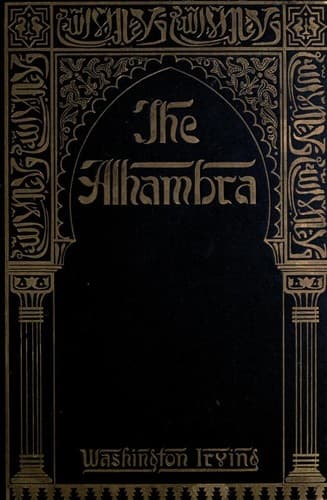
Verhalen over het gebouwencomplex in Granada, dat eigendom was van de laatste islamitische vorsten in Spanje.
The feast, for a set dinner in Spain is literally a feast, was served in
the beautiful Morisco Hall of “Las dos Hermanas.” The table was loaded
with all the luxuries of the season: there was an almost interminable
succession of dishes; showing how truly the feast at the rich Camachos’
wedding in “Don Quixote” was a picture of a Spanish banquet. A joyous
conviviality prevailed round the board; for though Spaniards are
generally abstemious, they are complete revellers on occasions like the
present, and none more so than the Andalusians. For my part, there was
something peculiarly exciting in thus sitting at a feast in the royal
halls of the Alhambra, given by one who might claim remote affinity with
its Moorish kings, and who was a lineal representative of Gonsalvo of
Cordova, one of the most distinguished of the Christian conquerors.
The banquet ended, the company adjourned to the Hall of Ambassadors.
Here every one endeavored to contribute to the general amusement,
singing, improvising, telling wonderful tales, or dancing popular dances
to that all-pervading talisman of Spanish pleasure, the guitar.
The count’s gifted little daughter was as usual the life and delight of
the assemblage, and I was more than ever struck with her aptness and
wonderful versatility. She took a part in two or three scenes of elegant
comedy with some of her companions, and performed them with exquisite
point and finished grace; she gave imitations of the popular Italian
singers, some serious, some comic, with a rare quality of voice, and, I
was assured, with singular fidelity; she imitated the dialects, dances,
ballads, and movements and manners of the gypsies and the peasants of
the Vega with equal felicity; but everything was done with an
all-pervading grace and a ladylike tact perfectly fascinating.
The great charm of everything she did was its freedom from pretension or
ambitious display, its happy spontaneity. Everything sprang from the
impulse of the moment; or was in prompt compliance with a request. She
seemed unconscious of the rarity and extent of her own talent, and was
like a child at home revelling in the buoyancy of its own gay and
innocent spirits. Indeed, I was told she had never exerted her talents
in general society, but only, as at present, in the domestic circle.
Her faculty of observation and her perception of character must have
been remarkably quick, for she could have had only casual and transient
glances at the scenes, manners, and customs depicted with such truth and
spirit. “Indeed it is a continual wonder to us,” said the countess,
“where the child [la Niña] has picked up these things, her life being
passed almost entirely at home, in the bosom of the family.”
Public-domain text, read in full here on John Shaqi.
Reviews
Reviews
No reviews yet
Be the first to share your thoughts on this work.
Elsewhere in the archive
Join the Discussion
Join the discussion
Sign in to leave a comment or review.
Sign InorCreate an account