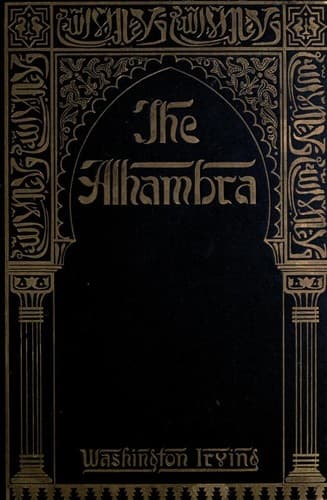
Verhalen over het gebouwencomplex in Granada, dat eigendom was van de laatste islamitische vorsten in Spanje.
On leaving Loxa we were joined by a cavalier, well-mounted and
well-armed, and followed on foot by an escopetero or musketeer. He
saluted us courteously, and soon let us into his quality. He was chief
of the customs, or rather, I should suppose, chief of an armed company
whose business it is to patrol the roads and look out for
contrabandistas. The escopetero was one of his guards. In the course of
our morning’s ride I drew from him some particulars concerning the
smugglers, who have risen to be a kind of mongrel chivalry in Spain.
They come into Andalusia, he said, from various parts, but especially
from La Mancha; sometimes to receive goods, to be smuggled on an
appointed night across the line at the plaza or strand of Gibraltar;
sometimes to meet a vessel, which is to hover on a given night off a
certain part of the coast. They keep together and travel in the night.
In the daytime they lie quiet in barrancos, gullies of the mountains, or
lonely farm-houses; where they are generally well received, as they make
the family liberal presents of their smuggled wares. Indeed, much of the
finery and trinkets worn by the wives and daughters of the mountain
hamlets and farm-houses are presents from the gay and open-handed
contrabandistas.
Arrived at the part of the coast where a vessel is to meet them, they
look out at night from some rocky point or headland. If they descry a
sail near the shore they make a concerted signal; sometimes it consists
in suddenly displaying a lantern three times from beneath the folds of a
cloak. If the signal is answered, they descend to the shore and prepare
for quick work. The vessel runs close in; all her boats are busy landing
the smuggled goods, made up into snug packages for transportation on
horseback. These are hastily thrown on the beach, as hastily gathered
up and packed on the horses, and then the contrabandistas clatter off to
the mountains. They travel by the roughest, wildest, and most solitary
roads, where it is almost fruitless to pursue them. The custom-house
guards do not attempt it: they take a different course. When they hear
of one of these bands returning full freighted through the mountains,
they go out in force, sometimes twelve infantry and eight horsemen, and
take their station where the mountain defile opens into the plain. The
infantry, who lie in ambush some distance within the defile, suffer the
band to pass, then rise and fire upon them. The contrabandistas dash
forward, but are met in front by the horsemen. A wild skirmish ensues.
The contrabandistas, if hard pressed, become desperate. Some dismount,
use their horses as breastworks, and fire over their backs; others cut
the cords, let the packs fall off to delay the enemy, and endeavor to
escape with their steeds. Some get off in this way with the loss of
their packages; some are taken, horses, packages, and all; others
abandon everything, and make their escape by scrambling up the
mountains.
Public-domain text, read in full here on John Shaqi.
Reviews
Reviews
No reviews yet
Be the first to share your thoughts on this work.
Join the Discussion
Join the discussion
Sign in to leave a comment or review.
Sign InorCreate an account