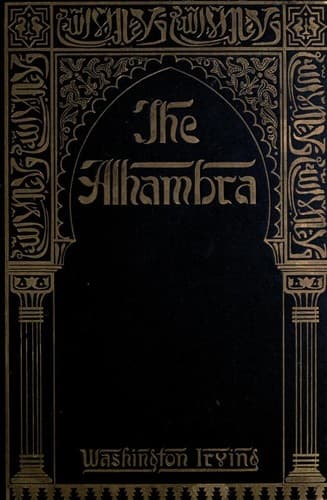
Verhalen over het gebouwencomplex in Granada, dat eigendom was van de laatste islamitische vorsten in Spanje.
In the latter part of my sojourn in the Alhambra, I made frequent
descents into the Jesuit’s Library of the University; and relished more
and more the old Spanish chronicles, which I found there bound in
parchment. I delight in those quaint histories which treat of the times
when the Moslems maintained a foothold in the Peninsula. With all their
bigotry and occasional intolerance, they are full of noble acts and
generous sentiments, and have a high, spicy, Oriental flavor, not to be
found in other records of the times, which were merely European. In
fact, Spain, even at the present day, is a country apart; severed in
history, habits, manners, and modes of thinking, from all the rest of
Europe. It is a romantic country; but its romance has none of the
sentimentality of modern European romance; it is chiefly derived from
the brilliant regions of the East, and from the high-minded school of
Saracenic chivalry.
The Arab invasion and conquest brought a higher civilization, and a
nobler style of thinking, into Gothic Spain. The Arabs were a
quick-witted, sagacious, proud-spirited, and poetical people, and were
imbued with Oriental science and literature. Wherever they established a
seat of power, it became a rallying-place for the learned and
ingenious; and they softened and refined the people whom they conquered.
By degrees, occupancy seemed to give them an hereditary right to their
foothold in the land; they ceased to be looked upon as invaders, and
were regarded as rival neighbors. The Peninsula, broken up into a
variety of states, both Christian and Moslem, became, for centuries, a
great campaigning-ground, where the art of war seemed to be the
principal business of man, and was carried to the highest pitch of
romantic chivalry. The original ground of hostility, a difference of
faith, gradually lost its rancor. Neighboring states, of opposite
creeds, were occasionally linked together in alliances, offensive and
defensive; so that the cross and crescent were to be seen side by side,
fighting against some common enemy. In times of peace, too, the noble
youth of either faith resorted to the same cities, Christian or Moslem,
to school themselves in military science. Even in the temporary truces
of sanguinary wars, the warriors who had recently striven together in
the deadly conflicts of the field, laid aside their animosity, met at
tournaments, jousts, and other military festivities, and exchanged the
courtesies of gentle and generous spirits. Thus the opposite races
became frequently mingled together in peaceful intercourse, or if any
rivalry took place, it was in those high courtesies and nobler acts,
which bespeak the accomplished cavalier. Warriors, of opposite creeds,
became ambitious of transcending each other in magnanimity as well as
valor. Indeed, the chivalric virtues were refined upon to a degree
sometimes fastidious and constrained, but at other times inexpressibly
noble and affecting. The annals of the times teem with illustrious
Public-domain text, read in full here on John Shaqi.
Reviews
Reviews
No reviews yet
Be the first to share your thoughts on this work.
Elsewhere in the archive
Join the Discussion
Join the discussion
Sign in to leave a comment or review.
Sign InorCreate an account