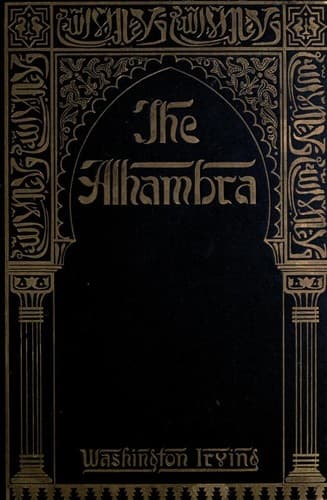
Verhalen over het gebouwencomplex in Granada, dat eigendom was van de laatste islamitische vorsten in Spanje.
instances of high-wrought courtesy, romantic generosity, lofty
disinterestedness, and punctilious honor, that warm the very soul to
read them. These have furnished themes for national plays and poems, or
have been celebrated in those all-pervading ballads, which are as the
life-breath of the people, and thus have continued to exercise an
influence on the national character, which centuries of vicissitude and
decline have not been able to destroy; so that, with all their faults,
and they are many, the Spaniards, even at the present day, are, on many
points, the most high-minded and proud-spirited people of Europe. It is
true, the romance of feeling derived from the sources I have mentioned,
has, like all other romance, its affectations and extremes. It renders
the Spaniard at times pompous and grandiloquent; prone to carry the
“pundonor,” or point of honor, beyond the bounds of sober sense and
sound morality; disposed, in the midst of poverty, to affect the “grande
caballero,” and to look down with sovereign disdain upon “arts
mechanical,” and all the gainful pursuits of plebeian life; but this
very inflation of spirit, while it fills his brain with vapors, lifts
him above a thousand meannesses; and though it often keeps him in
indigence, ever protects him from vulgarity.
In the present day, when popular literature is running into the low
levels of life, and luxuriating on the vices and follies of mankind; and
when the universal pursuit of gain is trampling down the early growth of
poetic feeling, and wearing out the verdure of the soul, I question
whether it would not be of service for the reader occasionally to turn
to these records of prouder times and loftier modes of thinking; and to
steep himself to the very lips in old Spanish romance.
With these preliminary suggestions, the fruit of a morning’s reading and
rumination in the old Jesuit’s Library of the University, I will give
him a legend in point, drawn forth from one of the venerable chronicles
alluded to.
LEGEND OF DON MUNIO SANCHO DE HINOJOSA
In the cloisters of the ancient Benedictine convent of San Domingo, at
Silos, in Castile, are the mouldering yet magnificent monuments of the
once powerful and chivalrous family of Hinojosa. Among these reclines
the marble figure of a knight, in complete armor, with the hands pressed
together, as if in prayer. On one side of his tomb is sculptured in
relief a band of Christian cavaliers, capturing a cavalcade of male and
female Moors; on the other side, the same cavaliers are represented
kneeling before an altar. The tomb, like most of the neighboring
monuments, is almost in ruins, and the sculpture is nearly
unintelligible, excepting to the keen eye of the antiquary. The story
connected with the sepulchre, however, is still preserved in the old
Spanish chronicles, and is to the following purport.
* * * * *
Public-domain text, read in full here on John Shaqi.
Reviews
Reviews
No reviews yet
Be the first to share your thoughts on this work.
Elsewhere in the archive
Join the Discussion
Join the discussion
Sign in to leave a comment or review.
Sign InorCreate an account