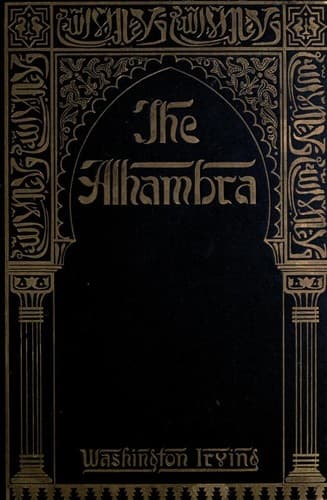
Verhalen over het gebouwencomplex in Granada, dat eigendom was van de laatste islamitische vorsten in Spanje.
The legend of Don Munio Sancho does not conclude with his death. On the
same day on which the battle took place on the plain of Salmanara, a
chaplain of the Holy Temple at Jerusalem, while standing at the outer
gate, beheld a train of Christian cavaliers advancing, as if in
pilgrimage. The chaplain was a native of Spain, and as the pilgrims
approached, he knew the foremost to be Don Munio Sancho de Hinojosa,
with whom he had been well acquainted in former times. Hastening to the
patriarch, he told him of the honorable rank of the pilgrims at the
gate. The patriarch, therefore, went forth with a grand procession of
priests and monks, and received the pilgrims with all due honor. There
were seventy cavaliers, beside their leader,--all stark and lofty
warriors. They carried their helmets in their hands, and their faces
were deadly pale. They greeted no one, nor looked either to the right or
to the left, but entered the chapel, and kneeling before the sepulchre
of our Saviour, performed their orisons in silence. When they had
concluded, they rose as if to depart, and the patriarch and his
attendants advanced to speak to them, but they were no more to be seen.
Every one marvelled what could be the meaning of this prodigy. The
patriarch carefully noted down the day, and sent to Castile to learn
tidings of Don Munio Sancho de Hinojosa. He received for reply, that on
the very day specified, that worthy knight, with seventy of his
followers, had been slain in battle. These, therefore, must have been
the blessed spirits of those Christian warriors, come to fulfil their
vow of pilgrimage to the Holy Sepulchre at Jerusalem. Such was Castilian
faith in the olden time, which kept its word, even beyond the grave.
* * * * *
If any one should doubt of the miraculous apparition of these phantom
knights, let him consult the History of the Kings of Castile and Leon,
by the learned and pious Fray Prudencio de Sandoval, bishop of Pamplona,
where he will find it recorded in the History of King Don Alonzo VI., on
the hundred and second page. It is too precious a legend to be lightly
abandoned to the doubter.
POETS AND POETRY OF MOSLEM ANDALUS
Public-domain text, read in full here on John Shaqi.
Reviews
Reviews
No reviews yet
Be the first to share your thoughts on this work.
Elsewhere in the archive
Join the Discussion
Join the discussion
Sign in to leave a comment or review.
Sign InorCreate an account