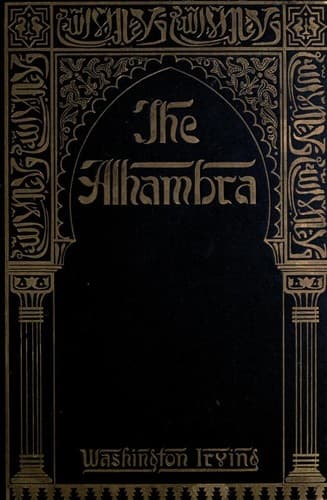
Verhalen over het gebouwencomplex in Granada, dat eigendom was van de laatste islamitische vorsten in Spanje.
During the latter part of my sojourn in the Alhambra I was more than
once visited by the Moor of Tetuan, with whom I took great pleasure in
rambling through the halls and courts, and getting him to explain to me
the Arabic inscriptions. He endeavored to do so faithfully; but, though
he succeeded in giving me the thought, he despaired of imparting an idea
of the grace and beauty of the language. The aroma of the poetry, said
he, is all lost in translation. Enough was imparted, however, to
increase the stock of my delightful associations with this extraordinary
pile. Perhaps there never was a monument more characteristic of an age
and people than the Alhambra; a rugged fortress without, a voluptuous
palace within; war frowning from its battlements; poetry breathing
throughout the fairy architecture of its halls. One is irresistibly
transported in imagination to those times when Moslem Spain was a region
of light amid Christian, yet benighted Europe; externally a warrior
power fighting for existence; internally a realm devoted to literature,
science, and the arts; where philosophy was cultivated with passion,
though wrought up into subtleties and refinements; and where the
luxuries of sense were transcended by those of thought and imagination.
Arab poetry, we are told, arrived at its highest splendor under the
Ommiades of Spain, who for a long time centred the power and splendor of
the western Caliphat at Cordova. Most of the sovereigns of that
brilliant line were themselves poets. One of the last of them was
Mahomed ben Abderahman. He led the life of a sybarite in the famous
palace and gardens of Azahara, surrounding himself with all that could
excite the imagination and delight the senses. His palace was the resort
of poets. His vizier, Ibn Zeydun, was called the Horace of Moslem Spain,
from his exquisite verses, which were recited with enthusiasm even in
the saloons of the Eastern Caliphs. The vizier became passionately
enamored of the princess Walada, daughter of Mahomed. She was the idol
of her father’s court, a poetess of the highest order, and renowned for
beauty as well as talent. If Ibn Zeydun was the Horace of Moslem Spain,
she was its Sappho. The princess became the subject of the vizier’s most
impassioned verses; especially of a famous risáleh or epistle addressed
to her which the historian Ash-Shakandi declares has never been equalled
for tenderness and melancholy. Whether the poet was happy in his love,
the authors I have consulted do not say; but one intimates that the
princess was discreet as she was beautiful, and caused many a lover to
sigh in vain. In fact, the reign of love and poetry in the delicious
abode of Zahara, was soon brought to a close by a popular insurrection.
Mahomed with his family took refuge in the fortress of Ucles, near
Toledo, where he was treacherously poisoned by the Alcayde; and thus
perished one of the last of the Ommiades.
Public-domain text, read in full here on John Shaqi.
Reviews
Reviews
No reviews yet
Be the first to share your thoughts on this work.
Elsewhere in the archive
Join the Discussion
Join the discussion
Sign in to leave a comment or review.
Sign InorCreate an account