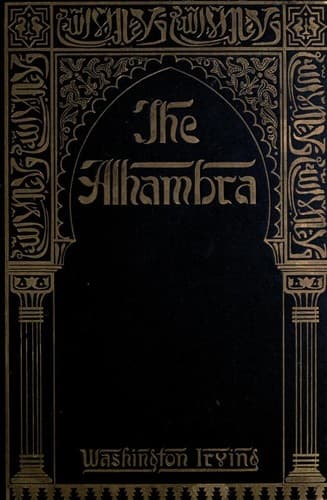
Verhalen over het gebouwencomplex in Granada, dat eigendom was van de laatste islamitische vorsten in Spanje.
In the height of their happiness a change took place in the government
of Granada. It was the time when the Almohades, a Berber tribe of Mount
Atlas, had acquired the control of Moslem Spain, and removed the seat of
government from Cordova to Morocco. The Sultan Abdelmuman governed Spain
through his Walis and Alcaydes; and his son, Sidi Abu Said, was made
Wali of Granada. He governed in his father’s name with royal state and
splendor, and with despotic sway. Being a stranger in the country, and a
Moor by birth, he sought to strengthen himself by drawing round him
popular persons of the Arab race; and to this effect made Ahmed, who was
then in the zenith of his fame and popularity, his vizier. Ahmed would
have declined the post, but the Wali was peremptory. Its duties were
irksome to him, and he spurned at its restraint. On a hawking-party,
with some of his gay companions, he gave way to his poetic vein,
exulting in his breaking away from the thraldom of a despotic master
like a hawk from the jesses of the falconer, to follow the soaring
impulses of his soul.
His words were repeated to Sidi Abu Said. “Ahmed,” said the informant,
“spurns at restraint and scoffs at thy authority.” The poet was
instantly dismissed from office. The loss of an irksome post was no
grievance to one of his joyous temperament; but he soon discovered the
real cause of his removal. The Wali was his rival. He had seen and
become enamored of Hafsah. What was worse, Hafsah was dazzled with the
conquest she had made.
For a time Ahmed treated the matter with ridicule; and appealed to the
prejudice existing between the Arab and Moorish races. Sidi Abu Said was
of a dark olive complexion. “How canst thou endure that black man?” said
he, scornfully. “By Allah, for twenty dinars I can buy thee a better
than he in the slave-market.”
The scoff reached the ears of Sidi Abu Said and rankled in his heart.
At other times Ahmed gave way to grief and tenderness, recalling past
scenes of happiness, reproaching Hafsah with her inconstancy, and
warning her in despairing accents that she would be the cause of his
death. His words were unheeded. The idea of having the son of the Sultan
for a lover had captivated the imagination of the poetess.
Maddened by jealousy and despair, Ahmed joined in a conspiracy against
the ruling dynasty. It was discovered, and the conspirators fled from
Granada. Some escaped to a castle on the mountains, Ahmed took refuge in
Malaga, where he concealed himself, intending to embark for Valencia. He
was discovered, loaded with chains, and thrown into a dungeon, to abide
the decision of Sidi Abu Said.
He was visited in prison by a nephew, who has left on record an account
of the interview. The youth was moved to tears at seeing his illustrious
relative, late so prosperous and honored, fettered like a malefactor.
Public-domain text, read in full here on John Shaqi.
Reviews
Reviews
No reviews yet
Be the first to share your thoughts on this work.
Elsewhere in the archive
Join the Discussion
Join the discussion
Sign in to leave a comment or review.
Sign InorCreate an account