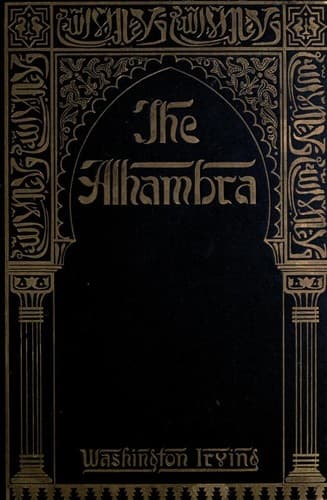
Verhalen over het gebouwencomplex in Granada, dat eigendom was van de laatste islamitische vorsten in Spanje.
The garden of Maumal was famous among the Moors for its rivulets, its
fountains, its flowers, and above all, its cypresses. It had its name
from a vizier of Abdallah, grandson of Aben Habuz, and Sultan of
Granada. Under the administration of this vizier many of the noblest
public works were executed. He constructed an aqueduct by which water
was brought from the mountains of Alfacar to irrigate the hills and
orchards north of the city. He planted a public walk with cypress-trees,
and “made delicious gardens for the solace of the melancholy Moors.”
“The name of Maumal,” says Alcántara, “ought to be preserved in Granada
in letters of gold.” Perhaps it is as well preserved by being associated
with the garden he planted; and by being mentioned in the verses of
Hafsah. How often does a casual word from a poet confer immortality!
Perhaps the reader may be curious to learn something of the story of
Hafsah and her lover, thus connected with one of the beautiful
localities of Granada. The following are all the particulars I have been
able to rescue out of the darkness and oblivion which have settled upon
the brightest names and geniuses of Moslem Spain.
Ahmed and Hafsah flourished in the sixth century of the Hegira; the
twelfth of the Christian Era. Ahmed was the son of the Alcayde of Alcala
la Real. His father designed him for public and military life, and would
have made him his lieutenant; but the youth was of a poetical
temperament, and preferred a life of lettered ease in the delightful
abodes of Granada. Here he surrounded himself by objects of taste in the
arts, and by the works of the learned; he divided his time between study
and social enjoyment. He was fond of the sports of the field, and kept
horses, hawks, and hounds. He devoted himself to literature, became
renowned for erudition, and his compositions in prose and verse were
extolled for their beauty, and in the mouths of every one.
Of a tender, susceptible heart, and extremely sensible to female charms,
he became the devoted lover of Hafsah. The passion was mutual, and for
once the course of true love appeared to run smooth. The lovers were
both young, equal in merit, fame, rank, and fortune, enamored of each
other’s genius as well as person, and inhabiting a region formed to be a
realm of love and poetry. A poetical intercourse was carried on between
them that formed the delight of Granada. They were continually
interchanging verses and epistles; “the poetry of which,” says the
Arabian writer, Al Makkari, “was like the language of doves.”
Public-domain text, read in full here on John Shaqi.
Reviews
Reviews
No reviews yet
Be the first to share your thoughts on this work.
Elsewhere in the archive
Join the Discussion
Join the discussion
Sign in to leave a comment or review.
Sign InorCreate an account