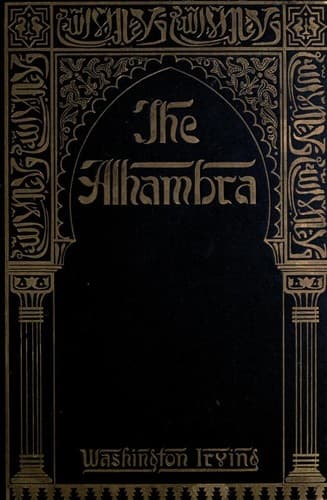
Verhalen over het gebouwencomplex in Granada, dat eigendom was van de laatste islamitische vorsten in Spanje.
These are simple details of simple pleasures; it is the nature of the
place alone that gives them interest and importance. I tread haunted
ground, and am surrounded by romantic associations. From earliest
boyhood, when, on the banks of the Hudson, I first pored over the pages
of old Gines Perez de Hytas’s apocryphal but chivalresque history of the
civil wars of Granada, and the feuds of its gallant cavaliers, the
Zegries and Abencerrages, that city has ever been a subject of my waking
dreams; and often have I trod in fancy the romantic halls of the
Alhambra. Behold for once a day-dream realized; yet I can scarce credit
my senses, or believe that I do indeed inhabit the palace of Boabdil,
and look down from its balconies upon chivalric Granada. As I loiter
through these Oriental chambers, and hear the murmur of fountains and
the song of the nightingale; as I inhale the odor of the rose, and feel
the influence of the balmy climate, I am almost tempted to fancy myself
in the paradise of Mahomet, and that the plump little Dolores is one of
the bright-eyed houris, destined to administer to the happiness of true
believers.
INHABITANTS OF THE ALHAMBRA
I have often observed that the more proudly a mansion has been tenanted
in the day of its prosperity, the humbler are its inhabitants in the day
of its decline, and that the palace of a king commonly ends in being the
nestling-place of the beggar.
The Alhambra is in a rapid state of similar transition. Whenever a tower
falls to decay, it is seized upon by some tatterdemalion family, who
become joint-tenants, with the bats and owls, of its gilded halls; and
hang their rags, those standards of poverty, out of its windows and
loopholes.
I have amused myself with remarking some of the motley characters that
have thus usurped the ancient abode of royalty, and who seem as if
placed here to give a farcical termination to the drama of human pride.
One of these even bears the mockery of a regal title. It is a little old
woman named Maria Antonia Sabonea, but who goes by the appellation of la
Reyna Coquina, or the Cockle-queen. She is small enough to be a fairy;
and a fairy she may be for aught I can find out, for no one seems to
know her origin. Her habitation is in a kind of closet under the outer
staircase of the palace, and she sits in the cool stone corridor, plying
her needle and singing from morning till night, with a ready joke for
every one that passes; for though one of the poorest, she is one of the
merriest little women breathing. Her great merit is a gift for
story-telling, having, I verily believe, as many stories at her command
as the inexhaustible Scheherezade of the Thousand and One Nights. Some
of these I have heard her relate in the evening tertulias of Dame
Antonia, at which she is occasionally a humble attendant.
Public-domain text, read in full here on John Shaqi.
Reviews
Reviews
No reviews yet
Be the first to share your thoughts on this work.
Join the Discussion
Join the discussion
Sign in to leave a comment or review.
Sign InorCreate an account