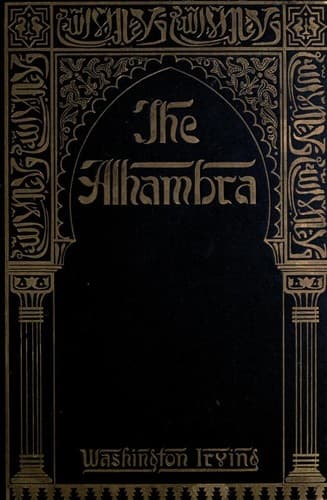
Verhalen over het gebouwencomplex in Granada, dat eigendom was van de laatste islamitische vorsten in Spanje.
Repelled within the limits of the Pyrenees, the mixed hordes of Asia and
Africa, that formed this great irruption, gave up the Moslem principle
of conquest, and sought to establish in Spain a peaceful and permanent
dominion. As conquerors, their heroism was only equalled by their
moderation; and in both, for a time, they excelled the nations with whom
they contended. Severed from their native homes, they loved the land
given them as they supposed by Allah, and strove to embellish it with
everything that could administer to the happiness of man. Laying the
foundations of their power in a system of wise and equitable laws,
diligently cultivating the arts and sciences, and promoting agriculture,
manufactures, and commerce, they gradually formed an empire unrivalled
for its prosperity by any of the empires of Christendom; and diligently
drawing round them the graces and refinements which marked the Arabian
empire in the East, at the time of its greatest civilization, they
diffused the light of Oriental knowledge through the western regions of
benighted Europe.
The cities of Arabian Spain became the resort of Christian artisans, to
instruct themselves in the useful arts. The universities of Toledo,
Cordova, Seville, and Granada were sought by the pale student from other
lands to acquaint himself with the sciences of the Arabs and the
treasured lore of antiquity; the lovers of the gay science resorted to
Cordova and Granada, to imbibe the poetry and music of the East; and the
steel-clad warriors of the North hastened thither to accomplish
themselves in the graceful exercises and courteous usages of chivalry.
If the Moslem monuments in Spain, if the Mosque of Cordova, the Alcazar
of Seville, and the Alhambra of Granada, still bear inscriptions fondly
boasting of the power and permanency of their dominion, can the boast be
derided as arrogant and vain? Generation after generation, century after
century, passed away, and still they maintained possession of the land.
A period elapsed longer than that which has passed since England was
subjugated by the Norman Conqueror, and the descendants of Musa and
Taric might as little anticipate being driven into exile across the same
straits, traversed by their triumphant ancestors, as the descendants of
Rollo and William, and their veteran peers, may dream of being driven
back to the shores of Normandy.
With all this, however, the Moslem empire in Spain was but a brilliant
exotic, that took no permanent root in the soil it embellished. Severed
from all their neighbors in the West by impassable barriers of faith and
manners, and separated by seas and deserts from their kindred of the
East, the Morisco-Spaniards were an isolated people. Their whole
existence was a prolonged, though gallant and chivalric struggle for a
foothold in a usurped land.
Public-domain text, read in full here on John Shaqi.
Reviews
Reviews
No reviews yet
Be the first to share your thoughts on this work.
Join the Discussion
Join the discussion
Sign in to leave a comment or review.
Sign InorCreate an account