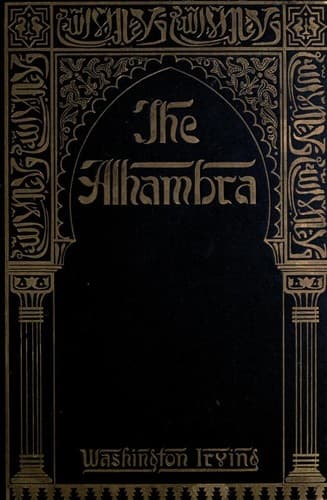
Verhalen over het gebouwencomplex in Granada, dat eigendom was van de laatste islamitische vorsten in Spanje.
By these means prosperity and abundance prevailed in
this beautiful city; its gates were thronged with commerce, and its
warehouses filled with luxuries and merchandise of every clime and
country.
He moreover gave premiums and privileges to the best artisans; improved
the breed of horses and other domestic animals; encouraged husbandry;
and increased the natural fertility of the soil twofold by his
protection, making the lovely valleys of his kingdom to bloom like
gardens. He fostered also the growth and fabrication of silk, until the
looms of Granada surpassed even those of Syria in the fineness and
beauty of their productions. He moreover caused the mines of gold and
silver and other metals, found in the mountainous regions of his
dominions, to be diligently worked, and was the first king of Granada
who struck money of gold and silver with his name, taking great care
that the coins should be skilfully executed.
It was towards the middle of the thirteenth century, and just after his
return from the siege of Seville, that he commenced the splendid palace
of the Alhambra; superintending the building of it in person; mingling
frequently among the artists and workmen, and directing their labors.
Though thus magnificent in his works and great in his enterprises, he
was simple in his person and moderate in his enjoyments. His dress was
not merely void of splendor, but so plain as not to distinguish him from
his subjects. His harem boasted but few beauties, and these he visited
but seldom, though they were entertained with great magnificence. His
wives were daughters of the principal nobles, and were treated by him as
friends and rational companions. What is more, he managed to make them
live in friendship with one another. He passed much of his time in his
gardens; especially in those of the Alhambra, which he had stored with
the rarest plants and the most beautiful and aromatic flowers. Here he
delighted himself in reading histories, or in causing them to be read
and related to him, and sometimes, in intervals of leisure, employed
himself in the instruction of his three sons, for whom he had provided
the most learned and virtuous masters.
Public-domain text, read in full here on John Shaqi.
Reviews
Reviews
No reviews yet
Be the first to share your thoughts on this work.
Join the Discussion
Join the discussion
Sign in to leave a comment or review.
Sign InorCreate an account