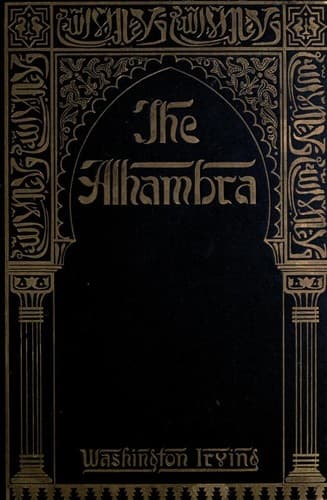
Verhalen over het gebouwencomplex in Granada, dat eigendom was van de laatste islamitische vorsten in Spanje.
At such times I am apt to seek the Hall of Justice, whose deep shadowy
arcades extend across the upper end of the court. Here was performed, in
presence of Ferdinand and Isabella and their triumphant court, the
pompous ceremonial of high mass, on taking possession of the Alhambra.
The very cross is still to be seen upon the wall, where the altar was
erected, and where officiated the Grand Cardinal of Spain, and others of
the highest religious dignitaries of the land. I picture to myself the
scene when this place was filled with the conquering host, that mixture
of mitred prelate and shaven monk, and steel-clad knight and silken
[Illustration: FOUNTAIN OF LIONS.]
courtier; when crosses and crosiers and religious standards were mingled
with proud armorial ensigns and the banners of the haughty chiefs of
Spain, and flaunted in triumph through these Moslem halls. I picture to
myself Columbus, the future discoverer of a world, taking his modest
stand in a remote corner, the humble and neglected spectator of the
pageant. I see in imagination the Catholic sovereigns prostrating
themselves before the altar, and pouring forth thanks for their victory;
while the vaults resound with sacred minstrelsy, and the deep-toned Te
Deum.
The transient illusion is over,--the pageant melts from the
fancy,--monarch, priest, and warrior return into oblivion with the poor
Moslems over whom they exulted. The hall of their triumph is waste and
desolate. The bat flits about its twilight vault, and the owl hoots from
the neighboring Tower of Comares.
Entering the Court of the Lions a few evenings since, I was almost
startled at beholding a turbaned Moor quietly seated near the fountain.
For a moment one of the fictions of the place seemed realized: an
enchanted Moor had broken the spell of centuries, and become visible. He
proved, however, to be a mere ordinary mortal: a native of Tetuan in
Barbary, who had a shop in the Zacatin of Granada, where he sold
rhubarb, trinkets, and perfumes. As he spoke Spanish fluently, I was
enabled to hold conversation with him, and found him shrewd and
intelligent. He told me that he came up the hill occasionally in the
summer, to pass a part of the day in the Alhambra, which reminded him of
the old palaces in Barbary, being built and adorned in similar style,
though with more magnificence.
As we walked about the palace, he pointed out several of the Arabic
inscriptions, as possessing much poetic beauty.
“Ah, Señor,” said he, “when the Moors held Granada, they were a gayer
people than they are nowadays. They thought only of love, music, and
poetry. They made stanzas upon every occasion, and set them all to
music. He who could make the best verses, and she who had the most
tuneful voice, might be sure of favor and preferment. In those days, if
any one asked for bread, the reply was, make me a couplet; and the
poorest beggar, if he begged in rhyme, would often be rewarded with a
piece of gold.”
Public-domain text, read in full here on John Shaqi.
Reviews
Reviews
No reviews yet
Be the first to share your thoughts on this work.
Elsewhere in the archive
Join the Discussion
Join the discussion
Sign in to leave a comment or review.
Sign InorCreate an account