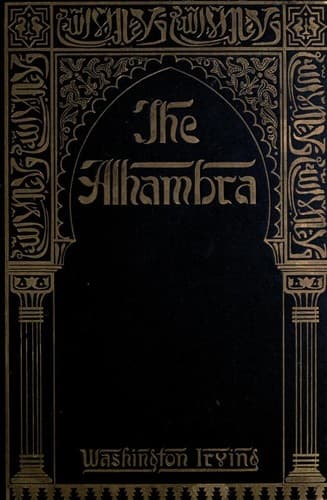
Verhalen over het gebouwencomplex in Granada, dat eigendom was van de laatste islamitische vorsten in Spanje.
“And is the popular feeling for poetry,” said I, “entirely lost among
you?”
“By no means, Señor; the people of Barbary, even those of the lower
classes, still make couplets, and good ones too, as in old times; but
talent is not rewarded as it was then; the rich prefer the jingle of
their gold to the sound of poetry or music.”
As he was talking, his eye caught one of the inscriptions which foretold
perpetuity to the power and glory of the Moslem monarchs, the masters of
this pile. He shook his head, and shrugged his shoulders, as he
interpreted it. “Such might have been the case,” said he; “the Moslems
might still have been reigning in the Alhambra, had not Boabdil been a
traitor, and given up his capital to the Christians. The Spanish
monarchs would never have been able to conquer it by open force.”
I endeavored to vindicate the memory of the unlucky Boabdil from this
aspersion, and to show that the dissensions which led to the downfall of
the Moorish throne originated in the cruelty of his tiger-hearted
father; but the Moor would admit of no palliation.
“Muley Abul Hassan,” said he, “might have been cruel; but he was brave,
vigilant, and patriotic. Had he been properly seconded, Granada would
still have been ours; but his son Boabdil thwarted his plans, crippled
his power, sowed treason in his palace, and dissension in his camp. May
the curse of God light upon him for his treachery!” With these words
the Moor left the Alhambra.
The indignation of my turbaned companion agrees with an anecdote related
by a friend, who, in the course of a tour in Barbary, had an interview
with the Pacha of Tetuan. The Moorish governor was particular in his
inquiries about Spain, and especially concerning the favored region of
Andalusia, the delights of Granada, and the remains of its royal palace.
The replies awakened all those fond recollections, so deeply cherished
by the Moors, of the power and splendor of their ancient empire in
Spain. Turning to his Moslem attendants, the Pacha stroked his beard,
and broke forth in passionate lamentations, that such a sceptre should
have fallen from the sway of true believers. He consoled himself,
however, with the persuasion, that the power and prosperity of the
Spanish nation were on the decline; that a time would come when the
Moors would conquer their rightful domains; and that the day was perhaps
not far distant when Mohammedan worship would again be offered up in the
Mosque of Cordova, and a Mohammedan prince sit on his throne in the
Alhambra.
Public-domain text, read in full here on John Shaqi.
Reviews
Reviews
No reviews yet
Be the first to share your thoughts on this work.
Elsewhere in the archive
Join the Discussion
Join the discussion
Sign in to leave a comment or review.
Sign InorCreate an account