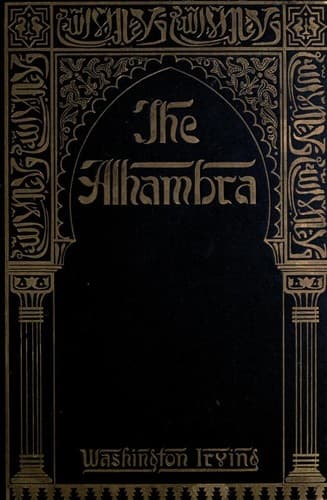
Verhalen over het gebouwencomplex in Granada, dat eigendom was van de laatste islamitische vorsten in Spanje.
Such is the general aspiration and belief among the Moors of Barbary;
who consider Spain, or Andaluz, as it was anciently called, their
rightful heritage, of which they have been despoiled by treachery and
violence. These ideas are fostered and perpetuated by the descendants of
the exiled Moors of Granada, scattered among the cities of Barbary.
Several of these reside in Tetuan, preserving their ancient names, such
as Paez and Medina, and refraining from inter-marriage with any families
who cannot claim the same high origin. Their vaunted lineage is regarded
with a degree of popular deference rarely shown in Mohammedan
communities to any hereditary distinction, excepting in the royal line.
These families, it is said, continue to sigh after the terrestrial
paradise of their ancestors, and to put up prayers in their mosques on
Fridays, imploring Allah to hasten the time when Granada shall be
restored to the faithful: an event to which they look forward as fondly
and confidently as did the Christian crusaders to the recovery of the
Holy Sepulchre. Nay, it is added, that some of them retain the ancient
maps and deeds of the estates and gardens of their ancestors at Granada,
and even the keys of the houses; holding them as evidences of their
hereditary claims, to be produced at the anticipated day of restoration.
My conversation with the Moors set me to musing on the fate of Boabdil.
Never was surname more applicable than that bestowed upon him by his
subjects of el Zogoybi, or the Unlucky. His misfortunes began almost in
his cradle, and ceased not even with his death. If ever he cherished the
desire of leaving an honorable name on the historic page, how cruelly
has he been defrauded of his hopes! Who is there that has turned the
least attention to the romantic history of the Moorish domination in
Spain, without kindling with indignation at the alleged atrocities of
Boabdil? Who has not been touched with the woes of his lovely and gentle
queen, subjected by him to a trial of life and death, on a false charge
of infidelity? Who has not been shocked by his alleged murder of his
sister and her two children, in a transport of passion? Who has not felt
his blood boil at the inhuman massacre of the gallant Abencerrages,
thirty-six of whom, it is affirmed, he ordered to be beheaded in the
Court of Lions? All these charges have been reiterated in various forms;
they have passed into ballads, dramas, and romances, until they have
taken too thorough possession of the public mind to be eradicated. There
is not a foreigner of education that visits the Alhambra, but asks for
the fountain where the Abencerrages were beheaded; and gazes with
horror at the grated gallery where the queen is said to have been
confined; not a peasant of the Vega or the Sierra, but sings the story
in rude couplets, to the accompaniment of his guitar, while his hearers
learn to execrate the very name of Boabdil.
Public-domain text, read in full here on John Shaqi.
Reviews
Reviews
No reviews yet
Be the first to share your thoughts on this work.
Elsewhere in the archive
Join the Discussion
Join the discussion
Sign in to leave a comment or review.
Sign InorCreate an account