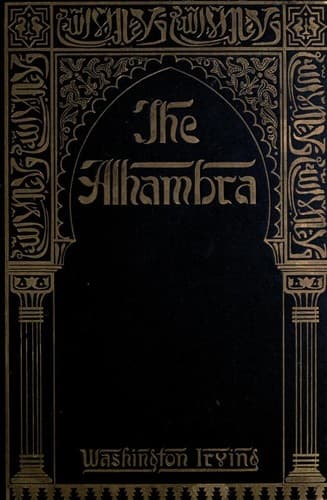
Verhalen over het gebouwencomplex in Granada, dat eigendom was van de laatste islamitische vorsten in Spanje.
A grand line of distinction existed among the Moslems of Spain, between
those of Oriental origin and those from Western Africa. Among the former
the Arabs considered themselves the purest race, as being descended from
the countrymen of the Prophet, who first raised the standard of Islam;
among the latter, the most warlike and powerful were the Berber tribes
from Mount Atlas and the deserts of Sahara, commonly known as Moors, who
subdued the tribes of the seacoast, founded the city of Morocco, and for
a long time disputed with the Oriental races the control of Moslem
Spain.
Among the Oriental races the Abencerrages held a distinguished rank,
priding themselves on a pure Arab descent from the Beni Seraj, one of
the tribes who were Ansares or Companions of the Prophet. The
Abencerrages flourished for a time at Cordova; but probably repaired to
Granada after the downfall of the Western Caliphat; it was there they
attained their historical and romantic celebrity, being foremost among
the splendid chivalry which graced the court of the Alhambra.
Their highest and most dangerous prosperity was during the precarious
reign of Muhamed Nasar, surnamed El Hayzari, or the Left-handed. That
ill-starred monarch, when he ascended the throne in 1423, lavished his
favors upon this gallant line, making the head of the tribe, Jusef Aben
Zeragh, his vizier, or prime minister, and advancing his relatives and
friends to the most distinguished posts about the court. This gave great
offence to other tribes, and caused intrigues among their chiefs.
Muhamed lost popularity also by his manners. He was vain, inconsiderate,
and haughty; disdained to mingle among his subjects; forbade those
jousts and tournaments, the delight of high and low, and passed his time
in the luxurious retirement of the Alhambra. The consequence was a
popular insurrection: the palace was stormed; the king escaped through
the gardens, fled to the sea-coast, crossed in disguise to Africa, and
took refuge with his kinsman, the sovereign of Tunis.
Muhamed el Zaguer, cousin of the fugitive monarch, took possession of
the vacant throne. He pursued a different course from his predecessor.
He not only gave fêtes and tourneys, but entered the lists himself, in
grand and sumptuous array; he distinguished himself in managing his
horse, in tilting, riding at the ring, and other chivalrous exercises;
feasted with his cavaliers, and made them magnificent presents.
Public-domain text, read in full here on John Shaqi.
Reviews
Reviews
No reviews yet
Be the first to share your thoughts on this work.
Elsewhere in the archive
Join the Discussion
Join the discussion
Sign in to leave a comment or review.
Sign InorCreate an account