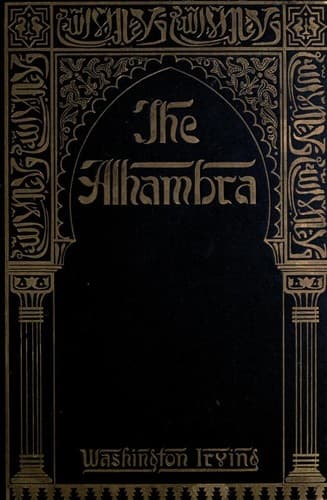
Verhalen over het gebouwencomplex in Granada, dat eigendom was van de laatste islamitische vorsten in Spanje.
Those who had been in favor with his predecessor, now experienced a
reverse; he manifested such hostility to them that more than five
hundred of the principal cavaliers left the city. Jusef Aben Zeragh,
with forty of the Abencerrages, abandoned Granada in the night, and
sought the court of Juan the king of Castile. Moved by their
representations, that young and generous monarch wrote letters to the
sovereign of Tunis, inviting him to assist in punishing the usurper and
restoring the exiled king to his throne. The faithful and indefatigable
vizier accompanied the bearer of these letters to Tunis, where he
rejoined his exiled sovereign. The letters were successful. Muhamed el
Hayzari landed in Andalusia with five hundred African horse, and was
joined by the Abencerrages and others of his adherents and by his
Christian allies; wherever he appeared the people submitted to him;
troops sent against him deserted to his standard; Granada was recovered
without a blow; the usurper retreated to the Alhambra, but was beheaded
by his own soldiers (1428), after reigning between two and three years.
El Hayzari, once more on the throne, heaped honors on the loyal vizier,
through whose faithful services he had been restored, and once more the
line of the Abencerrages basked in the sunshine of royal favor. El
Hayzari sent ambassadors to King Juan, thanking him for his aid, and
proposing a perpetual league of amity. The king of Castile required
homage and yearly tribute. These the left-handed monarch refused,
supposing the youthful king too much engaged in civil war to enforce his
claims. Again the kingdom of Granada was harassed by invasions, and its
Vega laid waste. Various battles took place with various success. But El
Hayzari’s greatest danger was near at home. There was at that time in
Granada a cavalier, Don Pedro Venegas by name, a Moslem by faith, but
Christian by descent, whose early history borders on romance. He was of
the noble house of Luque, but captured when a child, eight years of age,
by Cid Yahia Alnayar, prince of Almeria,[8] who adopted him as his son,
educated him in the Moslem faith, and brought him up among his children,
the Celtimerian princes, a proud family, descended in direct line from
Aben Hud, one of the early Granadian kings. A mutual attachment sprang
up between Don Pedro and the princess Cetimerien, a daughter of Cid
Yahia, famous for her beauty, and whose name is perpetuated by the ruins
of her palace in Granada--still bearing traces of Moorish elegance and
luxury. In process of time they were married; and thus a scion of the
Spanish house of Luque became engrafted on the royal stock of Aben Hud.
Public-domain text, read in full here on John Shaqi.
Reviews
Reviews
No reviews yet
Be the first to share your thoughts on this work.
Elsewhere in the archive
Join the Discussion
Join the discussion
Sign in to leave a comment or review.
Sign InorCreate an account