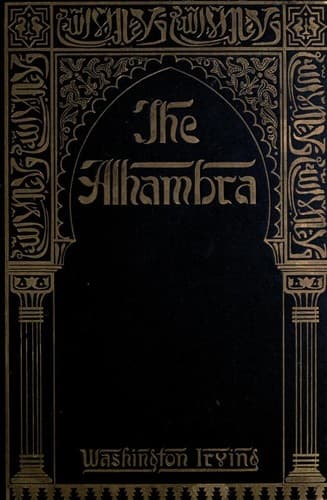
Verhalen over het gebouwencomplex in Granada, dat eigendom was van de laatste islamitische vorsten in Spanje.
Under the guidance of Mateo, I made my way through streets already
teeming with a holiday population, to the square of the Vivarrambla,
that great place for tilts and tourneys so often sung in the Moorish
ballads of love and chivalry. A gallery or arcade of wood had been
erected along the sides of the square, for the grand religious
procession of the following day. This was brilliantly illuminated for
the evening as a promenade; and bands of music were stationed on
balconies on each of the four façades of the square. All the fashion and
beauty of Granada, all of its population of either sex that had good
looks or fine clothes to display, thronged this arcade, promenading
round and round the Vivarrambla. Here, too, were the _Majos_ and
_Majas_, the rural beaux and belles, with fine forms, flashing eyes, and
gay Andalusian costumes; some of them from Ronda itself, that stronghold
of the mountains, famous for contrabandistas, bullfighters, and
beautiful women.
While this gay but motley throng kept up a constant circulation in the
gallery, the centre of the square was occupied by the peasantry from the
surrounding country; who made no pretensions to display, but came for
simple, hearty enjoyment. The whole square was covered with them;
forming separate groups of families and neighborhoods, like gypsy
encampments, some were listening to the traditional ballad drawled out
to the tinkling of the guitar; some were engaged in gay conversation;
some were dancing to the click of the castanet. As I threaded my way
through this teeming region with Mateo at my heels, I passed
occasionally some rustic party, seated on the ground, making a merry
though frugal repast. If they caught my eye as I loitered by, they
almost invariably invited me to partake of their simple fare. This
hospitable usage, inherited from their Moslem invaders, and originating
in the tent of the Arab, is universal throughout the land, and observed
by the poorest Spaniard.
As the night advanced, the gayety gradually died away in the arcades;
the bands of music ceased to play, and the brilliant crowd dispersed to
their homes. The centre of the square still remained well peopled, and
Mateo assured me that the greater part of the peasantry, men, women, and
children, would pass the night there, sleeping on the bare earth beneath
the open canopy of heaven. Indeed, a summer night requires no shelter in
this favored climate; and a bed is a superfluity which many of the hardy
peasantry of Spain never enjoy, and which some of them affect to
despise. The common Spaniard wraps himself in his brown cloak, stretches
himself on his manta or mule-cloth, and sleeps soundly, luxuriously
accommodated if he can have a saddle for a pillow. In a little while the
words of Mateo were made good; the peasant multitude nestled down on the
ground to their night’s repose, and by midnight the scene on the
Vivarrambla resembled the bivouac of an army.
Public-domain text, read in full here on John Shaqi.
Reviews
Reviews
No reviews yet
Be the first to share your thoughts on this work.
Elsewhere in the archive
Join the Discussion
Join the discussion
Sign in to leave a comment or review.
Sign InorCreate an account