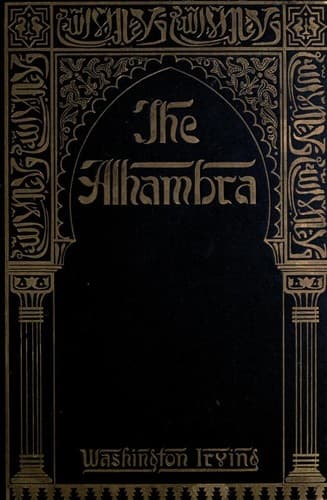
Verhalen over het gebouwencomplex in Granada, dat eigendom was van de laatste islamitische vorsten in Spanje.
The next morning, accompanied by Mateo, I revisited the square at
sunrise. It was still strewed with groups of sleepers: some were
reposing from the dance and revel of the evening; others, who had left
their villages after work on the preceding day, having trudged on foot
the greater part of the night, were taking a sound sleep to freshen
themselves for the festivities of the day. Numbers from the mountains,
and the remote villages of the plain, who had set out in the night,
continued to arrive with their wives and children. All were in high
spirits; greeting each other and exchanging jokes and pleasantries. The
gay tumult thickened as the day advanced. Now came pouring in at the
city gates, and parading through the streets, the deputations from the
various villages, destined to swell the grand procession. These village
deputations were headed by their priests, bearing their respective
crosses and banners, and images of the blessed Virgin and of patron
saints; all which were matters of great rivalship and jealousy among the
peasantry. It was like the chivalrous gatherings of ancient days, when
each town and village sent its chiefs, and warriors, and standards, to
defend the capital, or grace its festivities.
At length all these various detachments congregated into one grand
pageant, which slowly paraded round the Vivarrambla, and through the
principal streets, where every window and balcony was hung with
tapestry. In this procession were all the religious orders, the civil
and military authorities, and the chief people of the parishes and
villages: every church and convent had contributed its banners, its
images, its relics, and poured forth its wealth for the occasion. In the
centre of the procession walked the archbishop, under a damask canopy,
and surrounded by inferior dignitaries and their dependants. The whole
moved to the swell and cadence of numerous bands of music, and, passing
through the midst of a countless yet silent multitude, proceeded onward
to the cathedral.
I could not but be struck with the changes of times and customs, as I
saw this monkish pageant passing through the Vivarrambla, the ancient
seat of Moslem pomp and chivalry. The contrast was indeed forced upon
the mind by the decorations of the square. The whole front of the wooden
gallery erected for the procession, extending several hundred feet, was
faced with canvas, on which some humble though patriotic artist had
painted, by contract, a series of the principal scenes and exploits of
the Conquest, as recorded in chronicle and romance. It is thus the
romantic legends of Granada mingle themselves with everything, and are
kept fresh in the public mind.
Public-domain text, read in full here on John Shaqi.
Reviews
Reviews
No reviews yet
Be the first to share your thoughts on this work.
Elsewhere in the archive
Join the Discussion
Join the discussion
Sign in to leave a comment or review.
Sign InorCreate an account